
6 Best Youth Sports Fundraising Platforms (2026)
What is youth sports fundraising software?
6 Best Youth Sports Fundraising Platforms (2026)

Running a youth sports fundraising campaign used to mean selling candy bars, chasing payments, and hoping enough parents would volunteer. That's changing fast. Digital fundraising software now lets coaches and team organizers launch campaigns online, skip the product inventory, and reach donors with a shareable link.
With so many platforms available, picking the right one for your team can feel overwhelming. This guide breaks down six types of youth sports fundraising software so you can compare features, donor experience, and setup time before your next season.
Plantd gives youth sports teams a fully digital fundraiser where every athlete gets a personal page, donors give in a few taps, and coaches track results on a live dashboard.
Quick guide: 6 best youth sports fundraising platforms
Plantd: The best all-in-one digital fundraising software for youth sports teams wanting personal athlete pages and real-time tracking
Peer-to-peer a-thon platforms: Structured pledge drives tied to physical activities like fun runs or read-a-thons
General crowdfunding sites: One-page campaigns for quick, one-time fundraising needs
Product-based fundraising tools: Catalog-driven campaigns selling popcorn, candy, or discount cards
All-in-one nonprofit suites: Broader donor management tools with event and auction modules
Team management platforms with fundraising add-ons: Registration and scheduling software that includes a basic donation feature
How we chose the best youth sports fundraising software
We wanted to find platforms that actually make life easier for busy coaches, team parents, and small club organizers. Every option on this list was evaluated with your time and your donors' experience in mind.
Setup speed: How quickly can you go from signup to a live campaign page your athletes can share?
Athlete-level tracking: Can you see how much each player has raised individually so you can celebrate wins and motivate the group?
Donor experience: Is it easy for grandparents, neighbors, and family friends to donate from their phone in under a minute?
Custom-branded pages: Do athletes get personal pages with photos and goals, or does everyone share one generic link?
Admin workload: Does the platform handle payment processing, sharing materials, and thank-you messages, or does all of that land on your plate?
No-inventory model: Can your team raise money without selling, storing, or delivering physical products?
What is the best fundraising software for eco-friendly youth sports campaigns?
1. Plantd: Best overall youth sports fundraising software
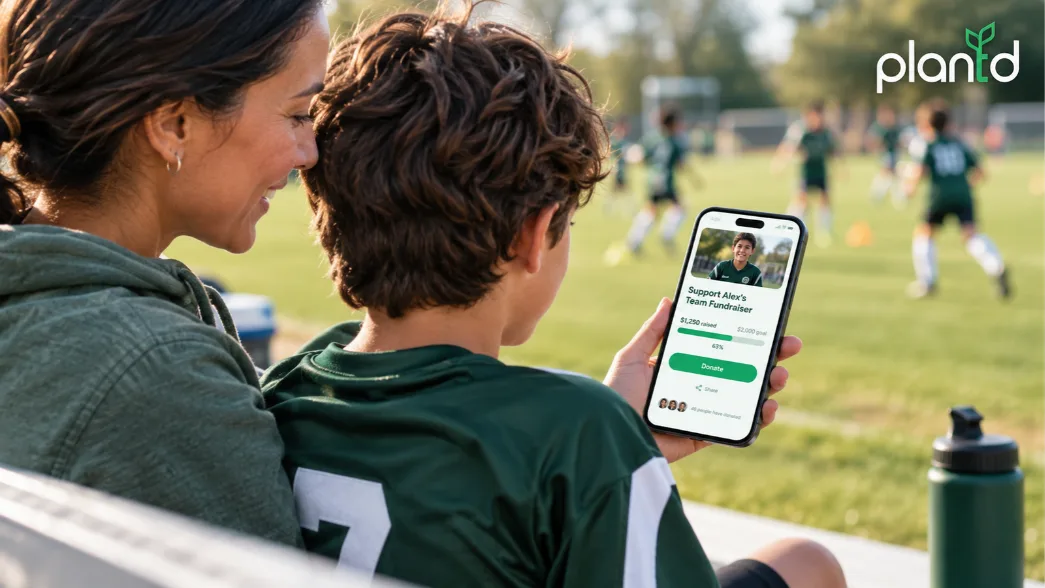
Plantd is digital fundraising software built specifically for youth, school, and club sports teams. There are no products to sell, no catalogs to distribute, and no cash to collect. Each athlete creates a personal fundraising page with photos, a video, and an individual goal. Supporters donate through a unique link in a few taps from any device.
Coaches and team parents get a live dashboard showing funds raised, donor counts, and individual athlete progress in real time. Leaderboards create friendly competition between players, and campaigns that hit their goals can unlock prizes. Plantd builds all your sharing materials for you, so there's nothing for volunteers to design or print.
Campaigns typically go live within 24 to 48 hours of a free onboarding call. Plantd campaigns report a $46 average donation and 75% team participation. Freehold Elite Gymnastics raised $30,750 with 460+ donors in a single month using the platform.
Plantd features
Personal athlete pages: Each player gets a custom page with photos, video, and a fundraising goal they can share with family and friends through a unique donation link.
Live fundraising dashboard: Coaches track total funds raised, individual athlete performance, and donor activity in real time without spreadsheets or manual updates.
Built-in leaderboards: Friendly competition between teammates drives higher participation and keeps athletes motivated through the entire campaign.
Team sharing materials: Plantd creates ready-to-use promotional graphics and social content so your volunteers spend zero time on design work.
Free onboarding support: A dedicated call walks you through setup from start to finish, and no technical experience is needed to get your campaign running.
100% digital, no inventory: Your team raises money without selling products, handling deliveries, or managing order forms.
Plantd pros and cons
Pros:
Campaigns go live in 24 to 48 hours with full onboarding support
Personal athlete pages drive higher donor engagement and a $46 average donation
Zero products, zero inventory, and zero delivery logistics for volunteers
Cons:
Focused on team campaigns, so individual athletes fundraising solo may find the team structure less relevant
Campaign length is optimized around 30 days, which may not suit teams looking for year-round passive collection
Currently focused on the U.S. market, so international teams should confirm availability
2. Peer-to-peer a-thon platforms: Activity-driven pledge campaigns
These platforms let your team run pledge-based campaigns tied to a physical activity like a fun run, swim-a-thon, or read-a-thon. Supporters pledge a set amount per lap, mile, or completed activity. This model works when your team already has an event planned and wants to layer fundraising on top of it.
Most a-thon platforms provide participant pages and automated pledge collection. Setup is typically straightforward, though campaigns depend heavily on event-day turnout. If the event gets rained out or attendance drops, your donations may fall short of projections.
Peer-to-peer a-thon platform features
Pledge-per-activity tracking: Supporters commit a dollar amount per lap, mile, or goal completed.
Participant pages: Athletes get individual pages to share with their supporters before the event.
Automated collection: Pledges convert to charges after the activity is completed, reducing manual follow-up.
Peer-to-peer a-thon platform pros and cons
Pros:
Ties fundraising to a fun team event that athletes enjoy
Pledge model can motivate athletes to push harder during the activity
Works for schools and clubs that already host annual events
Cons:
Revenue depends on event-day participation and attendance
Requires significant planning around a specific date and location
Donors outside your local area may not participate since giving is tied to an in-person event
3. General crowdfunding sites: One-page campaigns for quick needs
General crowdfunding platforms give you a single campaign page where supporters can donate. They're widely recognized and easy to set up. You typically write a description, set a goal, and share the link on social media.
For youth sports, the limitation is that these platforms aren't built for team fundraising. There's usually no per-athlete tracking, no leaderboard, and no way to see which players are driving donations. They work for one-off emergency needs but tend to lose momentum quickly for season-long campaigns.
General crowdfunding site features
Single campaign page: One shared link for the entire team or cause.
Social sharing tools: Easy sharing to social media platforms from the campaign page.
Broad donor reach: Name recognition means donors are familiar with the platform and trust the giving process.
General crowdfunding site pros and cons
Pros:
Familiar to most donors, which can reduce hesitation when giving
Quick to set up with minimal configuration
Works for emergency or one-time fundraising needs
Cons:
No per-athlete tracking or individual player pages
Campaigns compete for attention with millions of other causes on the same platform
Not designed for recurring team fundraising or season-long goals
4. Product-based fundraising tools: Catalog-driven campaigns
Product-based platforms let your team sell items like popcorn, cookie dough, or discount cards. Supporters buy a product, and a portion of the sale goes to your team. This is the traditional fundraising model that most parents and coaches remember from their own school days.
The trade-off is time. Someone has to manage orders, sort deliveries, collect payments, and chase down families who haven't turned in their forms. For small clubs with limited volunteer hours, the logistics can eat up more energy than the campaign generates.
Product-based fundraising tool features
Physical product catalog: Teams sell branded items from snacks to apparel to coupon books.
Order management: Platforms handle product fulfillment and shipping in many cases.
Familiar model: Parents and supporters understand the buy-to-give concept immediately.
Product-based fundraising tool pros and cons
Pros:
Supporters receive a tangible product in exchange for their contribution
Familiar concept that requires little explanation
Some platforms handle shipping and fulfillment directly
Cons:
Requires inventory management, order tracking, and delivery coordination
Profit margins on products can be lower than direct donation models
Harder to engage donors outside your immediate neighborhood since delivery adds complexity
5. All-in-one nonprofit suites: Donor management with event tools
These platforms are built for nonprofits that need donor CRM, email marketing, event registration, and auction tools in one place. They offer fundraising capabilities alongside broader organizational management features.
For youth sports teams, the main consideration is complexity. These suites are designed for organizations with dedicated staff managing donor relationships year-round. A volunteer coach or team parent may find the learning curve and feature set more than what's needed to run a single team campaign.
All-in-one nonprofit suite features
Donor CRM: Track supporter contact information and giving history over time.
Event and auction tools: Host ticketed events, silent auctions, and virtual galas from one platform.
Email marketing: Send updates and donation requests directly to your supporter list.
All-in-one nonprofit suite pros and cons
Pros:
Combines donor management, events, and fundraising in one place
Useful for large athletic departments or booster clubs with year-round operations
Provides data and reporting for long-term donor relationship building
Cons:
Feature-heavy platforms require more time to learn and configure
Designed for nonprofits with dedicated administrative staff, not volunteer-run teams
May include tools your team will never use, adding unnecessary complexity
6. Team management platforms with fundraising add-ons
Some sports team management platforms include a basic fundraising or donation collection feature alongside scheduling, roster management, and communication tools. If you already use one for team logistics, the built-in fundraising option means one less app to manage.
The trade-off is that fundraising is typically a secondary feature. You may not get personal athlete pages, live tracking, or donor engagement tools. For teams that want a dedicated fundraising experience with higher participation, a purpose-built platform like Plantd will deliver stronger results.
Team management platform features
Integrated scheduling and fundraising: Manage practices, games, and donation collection from one app.
Roster-based communication: Send updates to parents and players alongside fundraising reminders.
Basic donation pages: Accept contributions through a simple team page.
Team management platform pros and cons
Pros:
Convenient if your team already uses the platform for scheduling and communication
Reduces the number of tools coaches and parents need to manage
Simple donation collection for small, straightforward campaigns
Cons:
Fundraising features are limited compared to dedicated platforms
Typically no personal athlete pages, leaderboards, or live donation tracking
Donor experience may not be optimized for mobile giving or social sharing
Comparison table: The best youth sports fundraising software
Platform Type | Personal Athlete Pages | Live Dashboard | No Inventory Required |
Plantd | ✓ | ✓ | ✓ |
Peer-to-Peer A-Thon Platforms | ✓ | ✗ | ✓ |
General Crowdfunding Sites | ✗ | ✗ | ✓ |
Product-Based Fundraising | ✗ | ✗ | ✗ |
All-in-One Nonprofit Suites | ✗ | ✓ | ✓ |
Team Management Add-Ons | ✗ | ✗ | ✓ |
What should youth sports coaches look for in fundraising software?
Youth sports coaches should look for fundraising software that saves time and gets athletes involved. The right platform handles payment collection, builds your campaign materials, and gives each player a personal donation link to share with their network.
Look for features like real-time dashboards, athlete-level tracking, and mobile-friendly donor pages. If a platform asks you to manage inventory, sort deliveries, or design promotional materials yourself, that's time you could spend coaching. Plantd handles setup, sharing materials, and campaign support so coaches can focus on their team.
How can small sports clubs run a fundraiser without selling products?
Small sports clubs can run a fully digital fundraiser by using online fundraising software that accepts donations directly through personal athlete pages. Instead of selling candy or merchandise, each player shares a unique link with family, friends, and community members. Donors give in a few taps from their phone.
This approach eliminates inventory, delivery logistics, and the volunteer hours spent coordinating product sales. According to the Aspen Institute's 2025 Project Play survey, family spending on youth sports has risen 46% since 2019. A digital, no-product fundraiser for youth sports makes it easier for every supporter to contribute without adding to those costs.
Why Plantd is the best youth sports fundraising software?
Plantd takes the busywork out of youth sports fundraising and puts athletes at the center. Every player gets a personal page with a unique donation link, so your whole community can give in a few taps without buying a product they don't need.
What sets Plantd apart from other fundraising platforms is the combination of speed, simplicity, and athlete engagement. Campaigns go live within 24 to 48 hours. Live dashboards and leaderboards keep players motivated from start to finish. And with a reported $46 average donation and 75% participation rate, Plantd consistently helps teams raise more with less effort.
If you're a coach, team parent, or athletic director looking for online fundraising software that your entire team will rally behind, Plantd is built for you. Book a free onboarding call and get your campaign running this week.