

You’ve just finished a home renovation, new addition, fresh driveway, the works.
The crew is gone, the dust has settled, and everything looks exactly how you imagined it. Except that oak tree in the front yard, the one that’s been there longer than you have, is starting to look a little strange. Leaves thinner than usual. A few dead branches up top.
You ignore it, thinking it’s probably just the season. A year later, it’s dead.
Without a warning, the tree just gave up, and by the time you figured out why, the contractor had moved on to three other jobs.
This is one of the most common and least talked about things that happens during home construction. Trees get damaged not by one careless act but by a series of small oversights, equipment parked too close, soil piled against the trunk, roots cut to make room for a path. None of it looked serious at the time. For the tree, the effects can be irreversible.
Protecting trees during construction is not complicated, but it does require intention. In this blog, we walk you through what actually puts trees at risk, what you can do before the shovel hits the ground, and how to make sure your trees are still standing strong long after construction wraps up.
Most people think of tree damage as something visible, a trunk gashed by a machine, a branch snapped off by a reversing truck. That kind of damage does happen, but it’s rarely what kills a tree. What actually does the damage is mostly underground and mostly invisible.
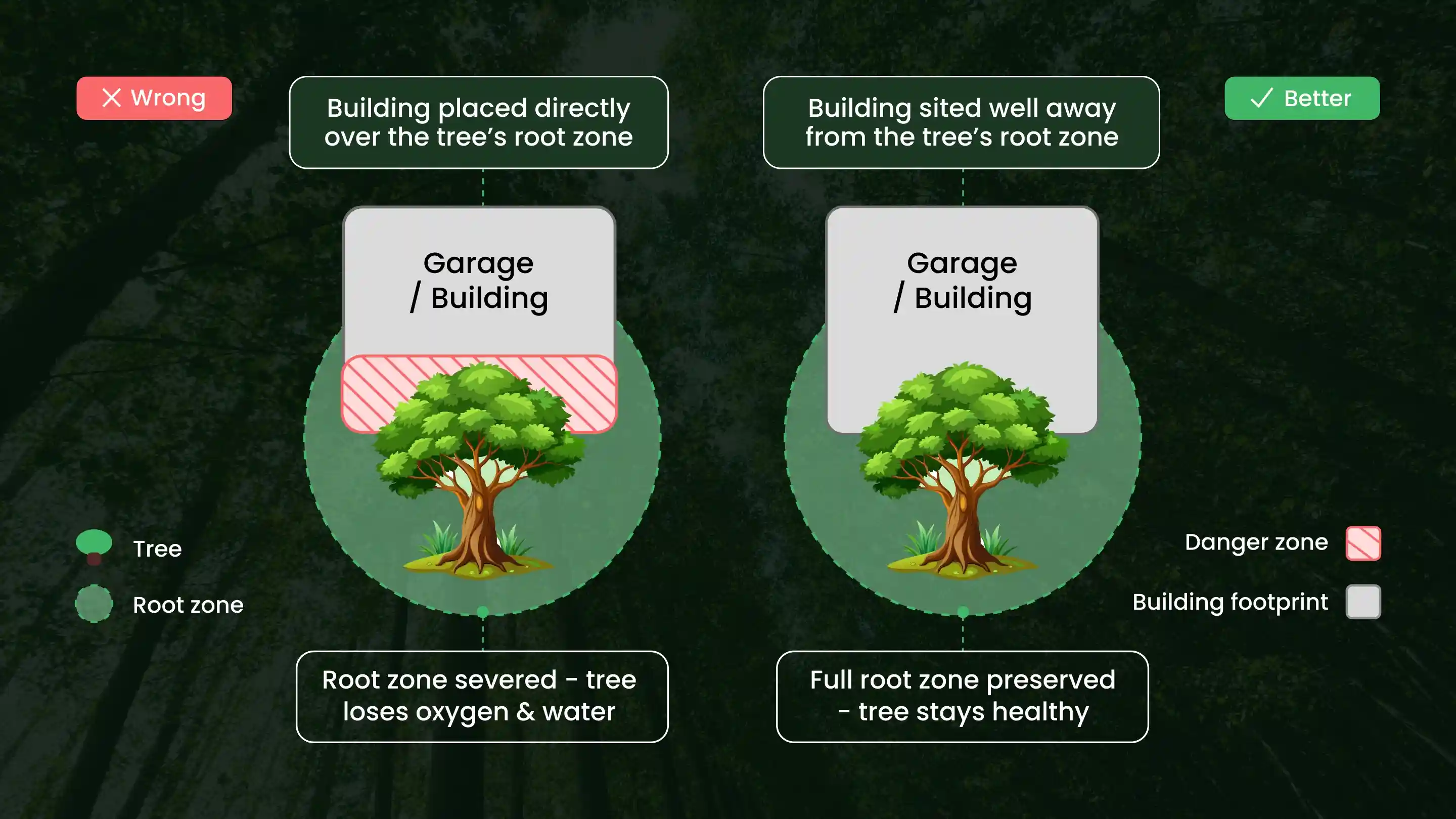
Tree roots spread much further than most people expect. They don’t just sit under the canopy; they stretch outward, sometimes as far as two to three times the width of the tree’s branches, sitting just a few inches below the surface where the soil is richest. This is called the root zone, and it’s incredibly sensitive to disturbance.
On a construction site, that root zone gets hit from multiple directions at once. Heavy machinery compacts the soil, squeezing out the air and moisture that roots depend on to survive. Changes to the ground level, even a few inches of added soil, can suffocate roots that have spent decades finding their depth. And when roots get cut to make way for a foundation, a pipe, or a new path, the tree loses its ability to take in water and nutrients from that entire side of its root system.
The reason this is so hard to catch is that trees don’t show the stress right away. They draw on stored energy to keep going for months, sometimes longer. By the time the symptoms show up, like thin foliage, dying branches, bark that's starting to crack, the damage is often too late and deep to reverse.
The most effective way to protect trees during construction doesn’t happen on the job site. It happens at the planning table, before the shovel breaks ground. Most tree loss is locked in the moment a building plan is finalized, without accounting for the trees already there. Here’s how to get ahead of it:
On a plat or sketch of your property, mark the location of every tree you want to keep. Not a mental note, but an actual drawing. This forces the conversation early, before construction logic takes over.
Where you site the house, garage, driveway, walkways, and patio all affect root zones. Once you have your tree locations marked, run every planned improvement against them. If a driveway cuts through a root zone, that needs to be on the table now, not after the concrete is poured.
A drawing never tells the full story. Physically stake out the planned footprint of your build and walk it. Seeing the actual boundary on the ground often reveals how close things are getting to a tree you assumed was safely out of the way. Sometimes shifting a building’s angle by a few degrees, or curving a walkway slightly, is all it takes to save a tree’s root space entirely.
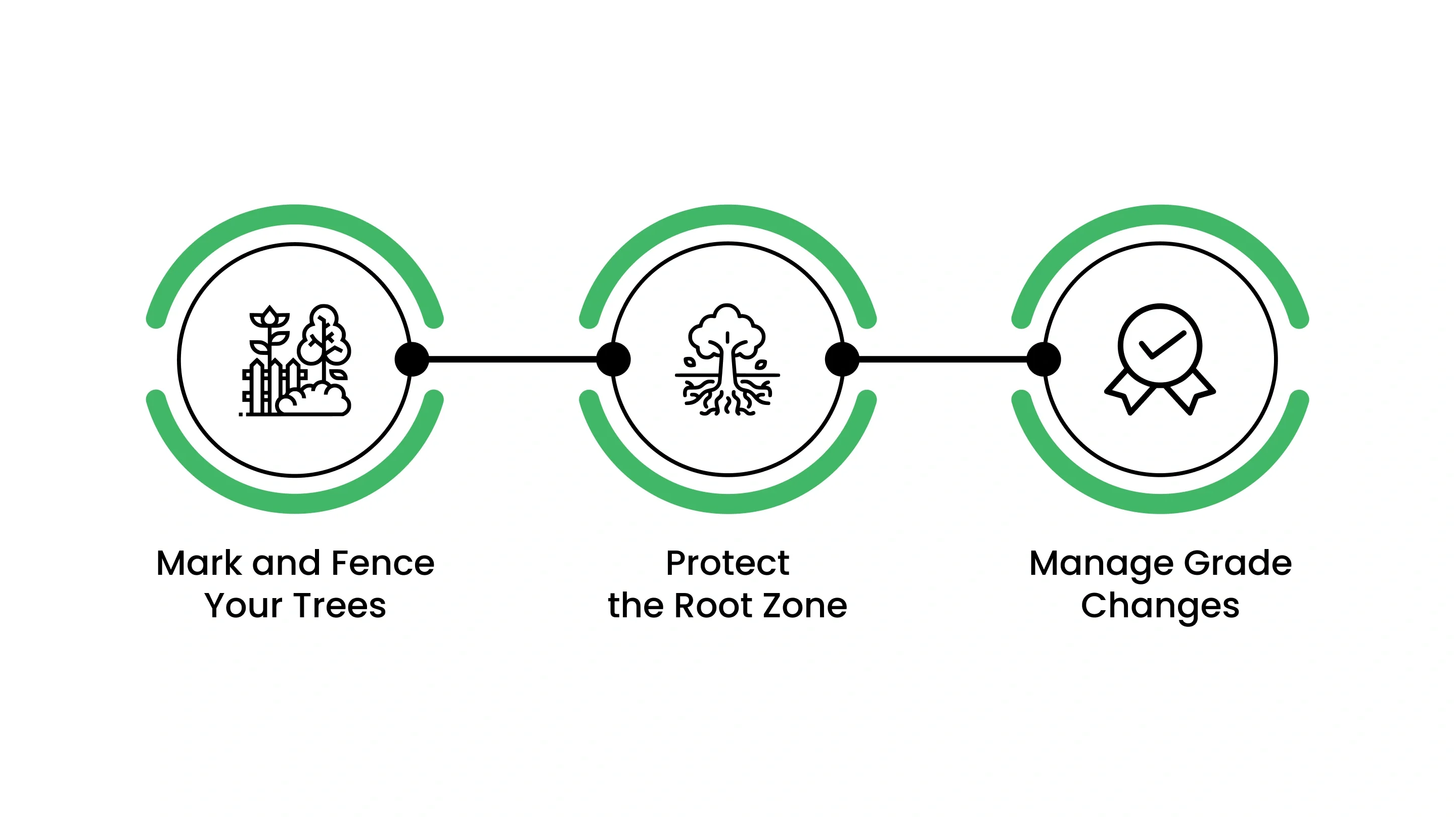
Planning gets you far, but once the crew arrives and machines start moving, the real work of protecting trees during construction begins. There are three things you need to have in place from day one:
One of the first and most important steps is making it absolutely clear which trees need to be protected. Every contractor, equipment operator, and worker on-site should know which trees are designated for preservation before work begins.
Temporary fencing should be installed around each protected tree before any construction activity starts. High-visibility fencing materials, flagged barriers, or brightly marked wire fencing work best because they are difficult to overlook on busy job sites.
The fenced area should extend to at least the tree’s drip line, which is the outer edge of the canopy where water naturally drips from the branches. This area protects a large portion of the root system, not just the trunk itself.
Inside this zone, there should be:
No heavy equipment traffic
No material storage
No trenching or excavation
No parking or staging areas
Even occasional activity inside the protected area can damage roots or compact the soil enough to affect the tree’s long-term health.
The root zone is where the most serious construction damage usually happens. While trunk wounds are visible immediately, root damage often goes unnoticed until the tree begins declining months or even years later.
Heavy machinery can compact soil around the roots, reducing oxygen and water flow that trees need to survive. Unlike surface damage, soil compaction is extremely difficult to reverse once it happens.
To reduce the risk:
Keep heavy equipment completely outside the drip line whenever possible
Avoid storing lumber, gravel, soil, or construction materials near tree bases
Prevent runoff, concrete washout, or chemical spills from reaching root zones
Designate separate access routes for machinery away from preserved trees
The drip line should always be treated as the minimum safe boundary. In many cases, giving trees even more space offers significantly better protection.
Changes in soil level can seriously affect tree health because roots rely on stable oxygen and moisture conditions. Adding or removing soil near a tree can suffocate roots, expose them, or disrupt the natural balance the tree depends on.
If grading work is unavoidable, careful planning becomes essential.
When soil fill must be added near a tree, a tree well can help protect the trunk and root flare. A stone or masonry well is built around the base of the tree to maintain the original soil level directly around the trunk.
Any added fill outside the well should be lightweight, porous, and gravelly enough to allow airflow and drainage. In most cases, fill depth should never exceed six inches near critical root zones.
If the site requires major slope or elevation changes, retaining walls may help reduce root disturbance. These walls should be placed far enough from the tree to preserve as much of the root system as possible.
The goal is always to minimize root cutting. Large roots play a major role in tree stability and water uptake, and excessive root loss can weaken or even kill the tree over time.
Construction may be finished, but the stress placed on trees often continues long after the equipment leaves the site. In many cases, trees show signs of stress months after construction is complete. Giving them the right support during this period can improve their chances of long-term survival. Here is what you can do:
Trees recovering from construction stress need consistent moisture, especially during hot or dry conditions. Shallow watering is usually not enough.
Instead, the soil should be watered deeply enough to reach approximately 12 to 18 inches below the surface, where the most important roots are located. Deep watering encourages healthier root recovery and helps reduce additional stress during dry spells.
Construction-related damage is not always immediate. A tree may appear healthy at first, but begin declining later as root damage affects its ability to absorb water and nutrients.
Some common warning signs include:
Wilting or thinning leaves
Early leaf drop outside seasonal patterns
Sparse canopy growth
Cracks or unusual changes in bark
Dead or weakening branches
Catching these issues early gives trees a better chance to recover before the damage becomes severe.
Broken or damaged branches should be pruned properly to prevent decay, disease, and additional stress. However, excessive or incorrect pruning can do more harm than good, especially for already stressed trees.
The goal should always be to remove damaged growth while preserving the tree’s overall structure and stability.
If a tree shows significant decline after construction, consulting a certified arborist can help identify underlying damage and recommend the best next steps. Professional assessments are especially valuable for mature trees, historic trees, or trees that play an important role in the surrounding landscape and ecosystem.
|
Want A Simple Reference You Can Follow During Your Project? Download our Tree Protection During Construction Checklist for practical tips on protecting roots, managing soil changes, and preserving healthy trees throughout construction. |
Taking steps to protect trees during construction helps preserve mature ecosystems that already provide shade, biodiversity, carbon storage, and environmental stability. These efforts can make a meaningful difference long after a project is complete.
But long-term environmental impact goes beyond a single construction site.
Supporting reforestation and restoration initiatives helps expand that impact by rebuilding green spaces, restoring damaged ecosystems, and creating healthier forests for future generations.
Every tree preserved during construction is one less tree lost to avoidable damage. Protecting existing trees while supporting new planting efforts creates a more sustainable approach to growth and development.
At Plantd, that long-term impact is at the center of every restoration effort. From supporting verified reforestation projects to helping businesses and individuals contribute to healthier ecosystems, Plantd focuses on creating measurable environmental change that lasts.
Whether you are preserving mature trees on a construction site or helping restore forests through new planting initiatives, every step toward protecting green spaces makes a difference.
With transparent tracking, verified projects, and a focus on long-term ecosystem restoration, Plantd ensures your contribution doesn’t just feel good; it actually makes a difference.