

When you plant a new tree, the first year determines almost everything that follows. Yet studies and field observations consistently show that 50 percent or more of newly planted trees do not survive beyond one or two years. In most cases, the problem is improper watering rather than pests or diseases.
Newly planted trees are especially vulnerable because their root systems are limited to the original root ball. They haven’t yet extended into the surrounding soil to access additional moisture. Too little water causes stress and root failure. Too much water suffocates roots and prevents oxygen from reaching them. Both can lead to decline.
Understanding how to properly water a newly planted tree is one of the most important steps to ensuring long-term success. The timing, frequency, and amount of water all matter. In this blog, we’ll break down exactly how often to water, how much to apply, where to direct it, and how to help your tree establish strong, healthy roots.
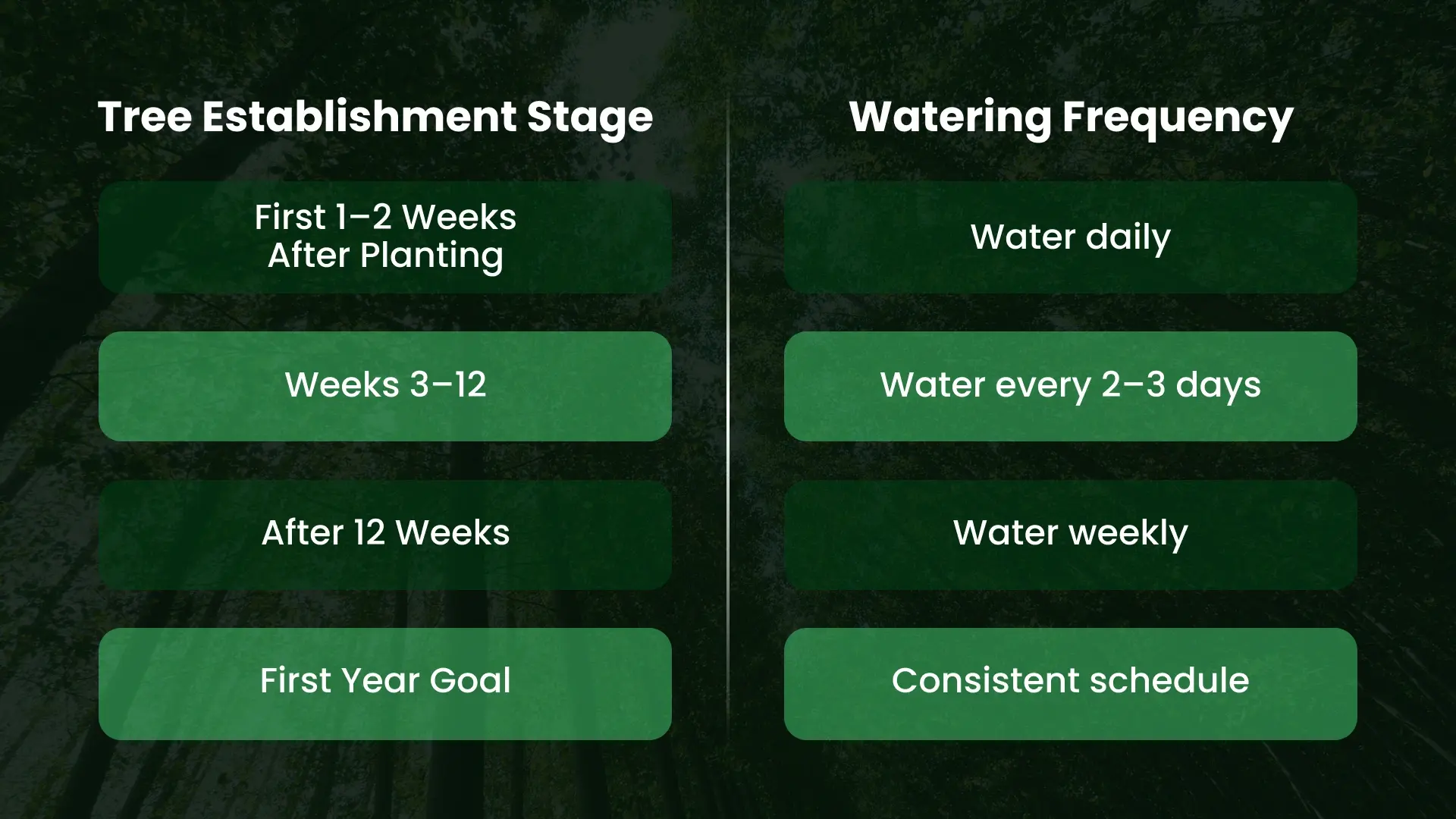
Watering frequency changes as the tree begins to establish. In the early stages, roots are confined to the original root ball and nearby soil. Over time, they expand outward and downward, allowing the tree to tolerate longer intervals between watering. Following a staged schedule helps prevent both drought stress and root rot.
During the first two weeks, water daily. This is the most critical period because the tree is adjusting to transplant shock and has not yet begun extending roots into the surrounding soil.
Focus on keeping both the root ball and the backfill soil consistently moist, not soaked. The soil should feel damp several inches below the surface, but never waterlogged. If you dig down and find dry soil around the root ball, increase watering slightly. If water is pooling or the soil feels muddy hours later, reduce the amount.
Rainfall can replace hand watering, but only if it is substantial. A light shower is not enough. As a general rule, skip a scheduled watering only if your area receives more than one inch of rain in a single day.
After the first two weeks, reduce watering to every 2 to 3 days. By this stage, the tree should begin extending roots slightly beyond the root ball, but it is still not fully established.
Before watering, check soil moisture. Insert a screwdriver or trowel 4–6 inches into the soil. If it slides in easily and the soil feels moist, wait another day. If it feels dry or resistant, water thoroughly.
During periods of extreme heat or high winds, trees may require slightly more frequent watering. Hot weather increases evaporation and transpiration, which means moisture leaves the soil and leaves faster. Adjust accordingly, but avoid overwatering simply because temperatures rise.
Once the tree has been in the ground for about three months, you can shift to weekly watering. Continue this schedule until the tree’s roots are fully established, which can take 1 to several growing seasons, depending on the tree's size.
Even at this stage, deep watering is important. Apply enough water to moisten the root zone to a depth of several inches. Shallow watering encourages shallow roots, which later reduce drought tolerance.
As with earlier stages, rainfall matters. If your area receives over one inch of rain in a day, you can skip that week’s scheduled watering. Light rainfall rarely penetrates deeply enough to replace a full irrigation cycle.
Consistent watering during the first year builds strong roots. As roots spread into the surrounding soil, the tree becomes more resilient and less dependent on supplemental irrigation.
A newly planted tree is considered established when its roots have expanded well beyond the original root ball and into the surrounding soil. Until that happens, the tree depends heavily on regular watering and careful monitoring.
For small trees, establishment typically takes one to two growing seasons. Larger trees take significantly longer. A general rule used in landscaping and arboriculture is that a tree requires about one year of establishment time for every inch of trunk diameter measured at planting.
To estimate this, measure the trunk diameter:
If the tree is 4 inches or smaller, measure the trunk 6 inches above the root flare.
If the tree is larger than 4 inches, measure 12 inches above the root flare.
Using that measurement:
A 1-inch caliper tree may establish in about 1 to 1.5 years.
A 3-inch tree may take 3 to 4 years.
A 5-inch tree may require 5 years or more.
Roots generally grow outward about 12 to 18 inches per year, depending on soil conditions, moisture levels, and overall care. In compacted soil or areas with heavy turf competition, growth can be slower. Proper mulching and consistent watering improve root expansion.
Even if the tree looks healthy above ground, the root system may still be limited. Continuing to water consistently until the tree is fully established ensures stronger roots, better drought tolerance, and long-term stability.
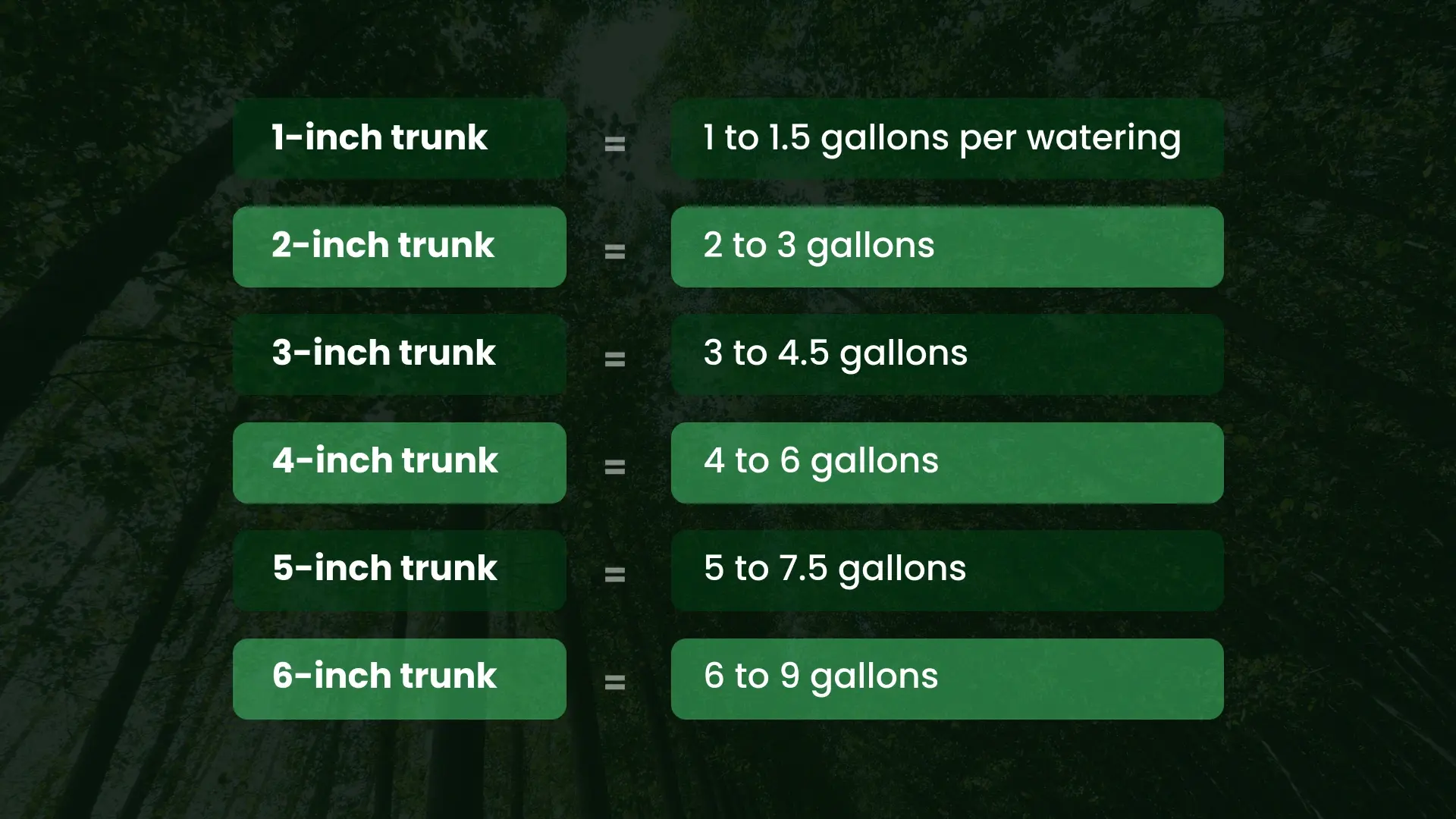
The amount of water a new tree needs depends largely on its trunk size, also called caliper. A common guideline is to apply 1 to 1.5 gallons of water per inch of trunk diameter at each watering. This ensures that moisture reaches the entire root ball and begins soaking into the surrounding soil.
Here’s a practical breakdown:
Apply the water slowly so it can soak into the soil rather than run off. The goal is deep moisture penetration, not surface wetness.
As the tree establishes and roots expand outward, the watering area should gradually increase. Roots typically grow 12 to 18 inches per year, meaning the original root ball is no longer the only zone that needs moisture. While frequency may decrease over time, the total volume per watering may need to increase slightly to match the expanding root system.
Deep, consistent watering encourages roots to grow downward and outward, which improves drought tolerance and long-term stability.
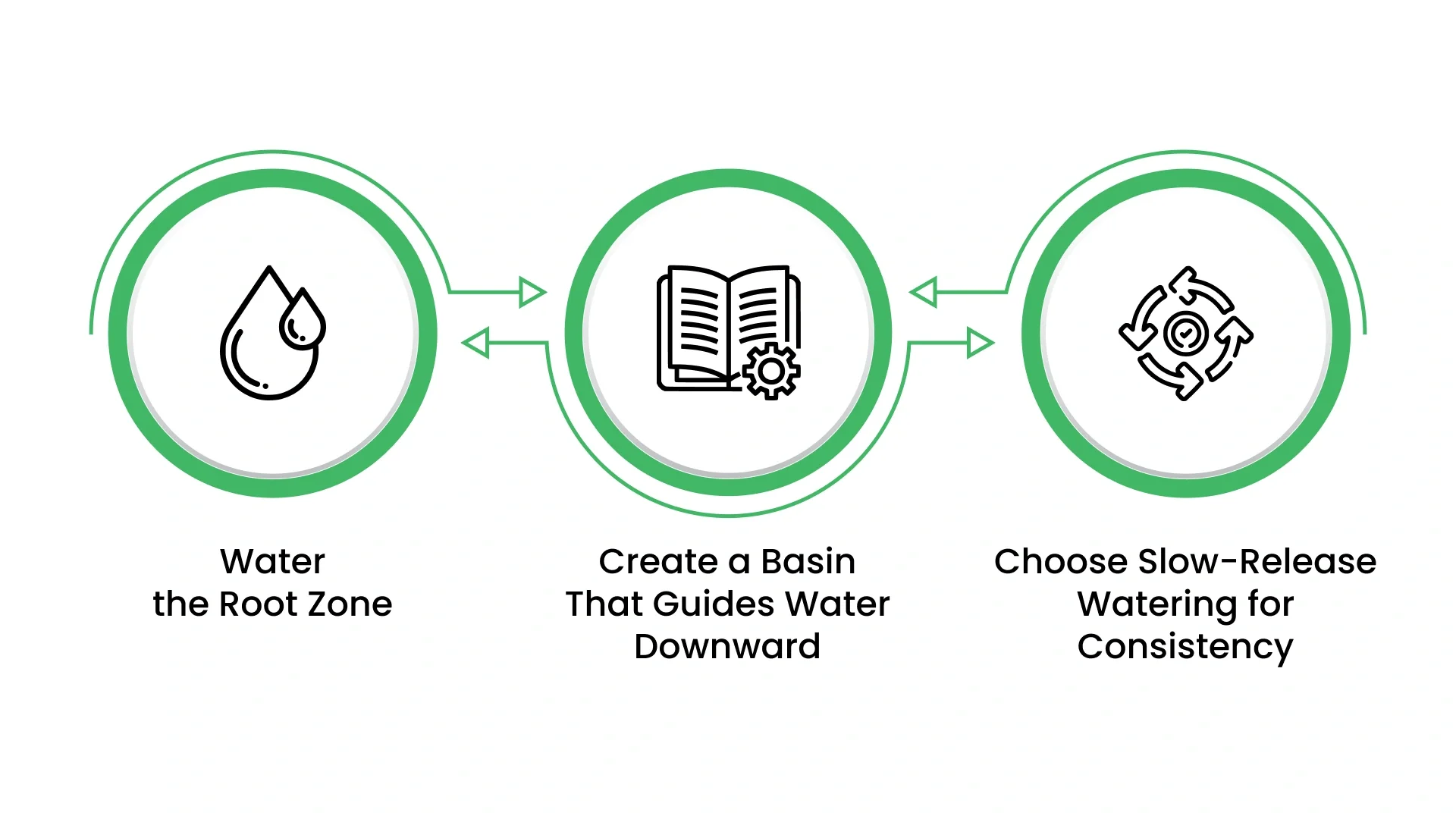
Knowing how often and how much to water is important, but how you apply the water matters just as much. Proper technique ensures moisture reaches the roots, encourages outward growth, and prevents common problems like runoff or shallow rooting.
Apply water directly over the root zone, not just at the base of the trunk. The root zone includes the original root ball and the surrounding backfill soil placed in the planting hole.
Keep the backfill soil consistently moist, especially during the first few months. If this area dries out, roots may struggle to expand beyond the root ball. Water should soak several inches deep into the soil.
As roots grow outward, gradually expand the watering area. Tree roots typically extend about 12 to 18 inches per year, depending on soil conditions. Adjust your watering circle so moisture reaches the developing roots.
A simple and effective technique is to build a small soil berm around the tree.
Create a circular mound of soil about 3 to 4 inches high around the outer edge of the root zone. This forms a shallow basin that holds water in place while it infiltrates the soil.
Fill this reservoir slowly using a gentle stream from a hose. Slow application allows water to penetrate deeply rather than running off the surface. Avoid flooding the area or creating standing water that remains for hours, as overly saturated soil reduces oxygen around the roots.
Tree watering bags can be useful for newly planted trees. These bags typically hold 14 to 15 gallons of water and release it gradually over several hours.
Slow trickle watering offers several advantages:
Promotes deep soil infiltration
Reduces runoff
Saves time compared to manual watering
Provides consistent moisture around the root ball
These systems are especially helpful during hot weather, for larger trees, or in areas where daily watering is difficult. They should still be monitored to ensure the soil does not remain constantly saturated.
Using proper watering technique helps build strong roots and improves long-term tree survival.
Planting a tree is an important first step. Making sure it survives is what creates real impact. Proper watering, mulching, and early care determine whether a young tree grows into a strong, climate-resilient asset or struggles in its first few years.
Plantd supports tree planting and restoration projects that prioritize long-term survival, not just planting numbers. From site selection to aftercare, these projects focus on giving trees the best chance to establish healthy root systems and grow for decades to come.
A tree’s first year determines its future. Support responsible tree planting with Plantd and help ensure today’s saplings become tomorrow’s forests.