
How Much CO₂ Does a Tree Absorb?
Most of us know that trees absorb carbon dioxide, but how much? If you’ve ever wondered whether one tree can really make a measurable difference, you’re not alone. It’s one of the most frequently asked questions people consider when thinking about planting trees or supporting reforestation. And the truth is: the answer isn’t as straightforward as a single number.
A tree’s CO₂ absorption changes as it grows. Different species absorb carbon at varying rates. Climate, soil, rainfall, sunlight, and even the health of the surrounding forest all shape how effectively a tree captures and stores carbon over time.
So when we ask, how much CO₂ does a tree absorb, what we’re really asking is: under what conditions, at what stage of growth, and for how long?
This blog unpacks that answer, starting with how trees actually absorb CO₂, followed by realistic yearly estimates, the critical factors that influence absorption, and how you can measure it over time.
How Do Trees Absorb CO₂?
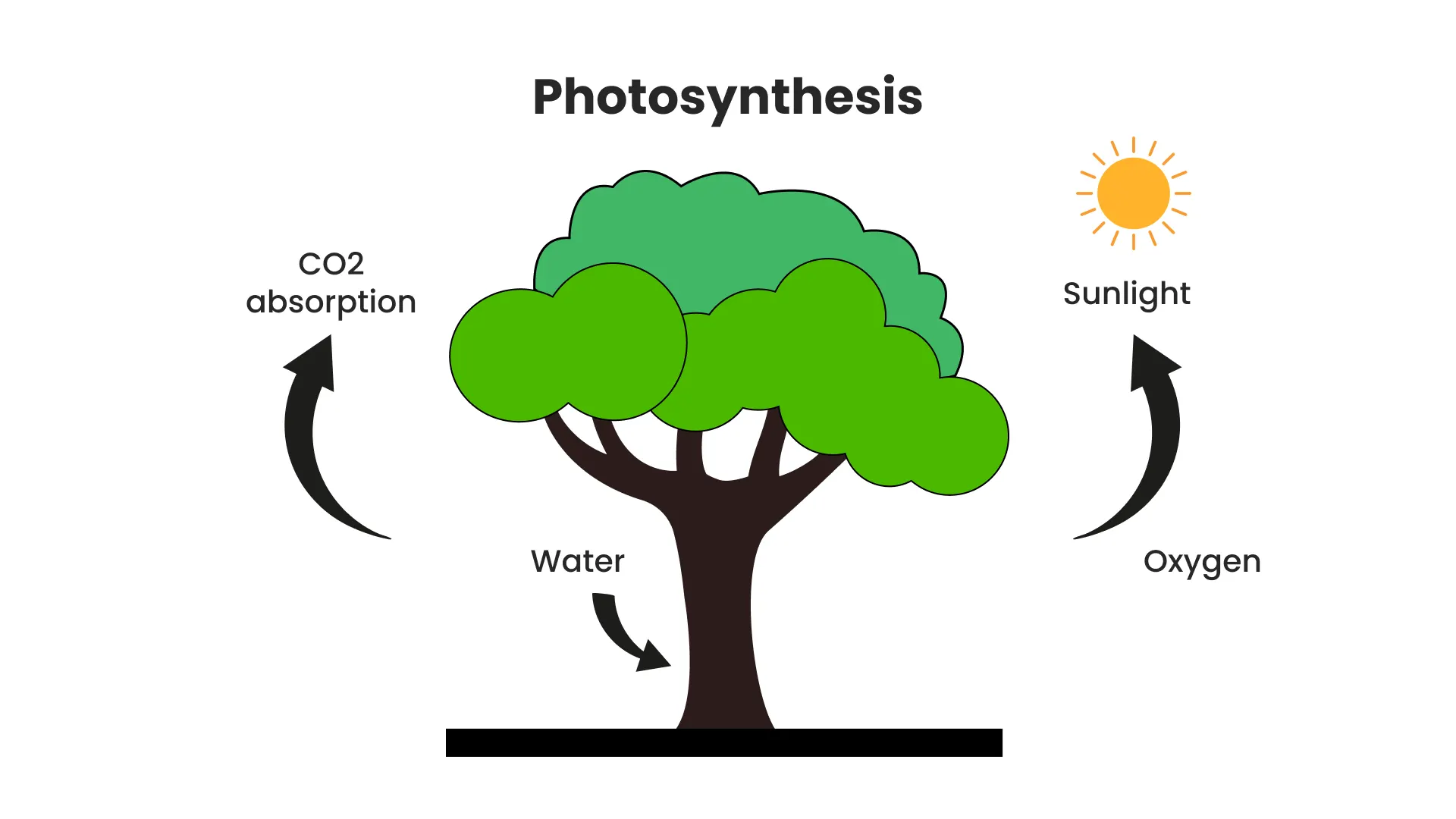
To understand how much CO₂ a tree absorbs, it helps to start with how the process actually works. Trees don’t just pull carbon from the air; they convert it into the very material they’re made of.
Every tree utilizes photosynthesis to absorb carbon dioxide from the atmosphere. Through tiny openings on their leaves called stomata, trees absorb CO₂, combine it with water drawn up from the roots, and use sunlight to convert it into glucose, the building block for new wood, bark, leaves, and roots. Oxygen is released as a by-product, while the carbon becomes locked inside the tree’s growing structure.
But carbon storage doesn’t stop at the trunk. Trees also move carbon below ground, storing it in their root systems and contributing to long-term carbon accumulation in the soil. Over time, this carbon becomes part of a stable pool that can remain stored for decades, even centuries in mature forests.
It’s this ability to convert atmospheric carbon into living biomass and retain it that makes trees such powerful natural climate tools. The exact amount they absorb each year depends on several factors, including their species, age, environment, and growth rate.
How Much CO₂ Does One Tree Actually Absorb?
When people ask how much CO₂ does a tree absorb, they’re usually hoping for one clear number. The reality is more nuanced, but we do have reliable ranges based on decades of forestry and ecosystem research.
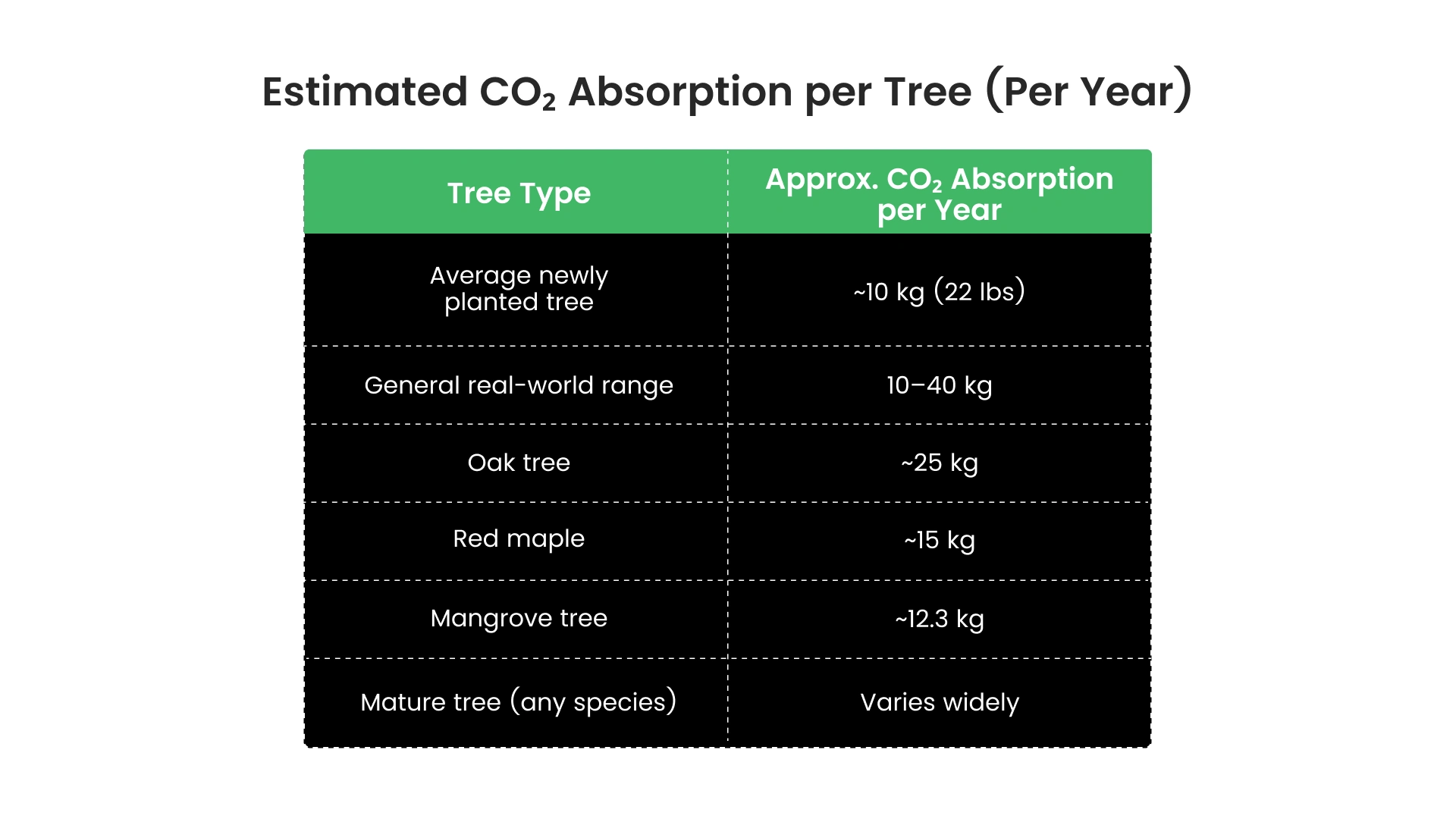
Most newly planted trees absorb around 10 kg (22 lbs) of CO₂ per year during their early growth stages. This is a widely accepted, conservative average used by many reforestation organisations because it reflects real-world conditions: varying species, mixed soil quality, and differing rainfall patterns.
In stronger growing environments, especially where soil is rich, sunlight is plentiful, and the species is fast-growing, a single tree can absorb 10 to 40 kg of CO₂ per year. That’s why some species-specific studies show numbers like:
-
Oak trees: ~25 kg per year
-
Red maple: ~15 kg per year
-
Mangroves: ~12.3 kg per year
These differences exist because each species builds biomass at a different pace. Fast-growing species add wood more quickly, which means they absorb more carbon annually. Slow-growing species take in less each year but often store more over their lifetime due to denser wood.
Another critical distinction is annual absorption vs. lifetime storage. A healthy mature tree may hold hundreds of kilograms of carbon in its trunk, branches, roots, and surrounding soil, but the rate at which it absorbs new carbon decreases as it ages.
While no single value applies to every tree everywhere, the ranges above provide a realistic, science-backed approach to understanding the climate impact of planting and nurturing a single tree.
Factors That Affect a Tree’s CO₂ Absorption
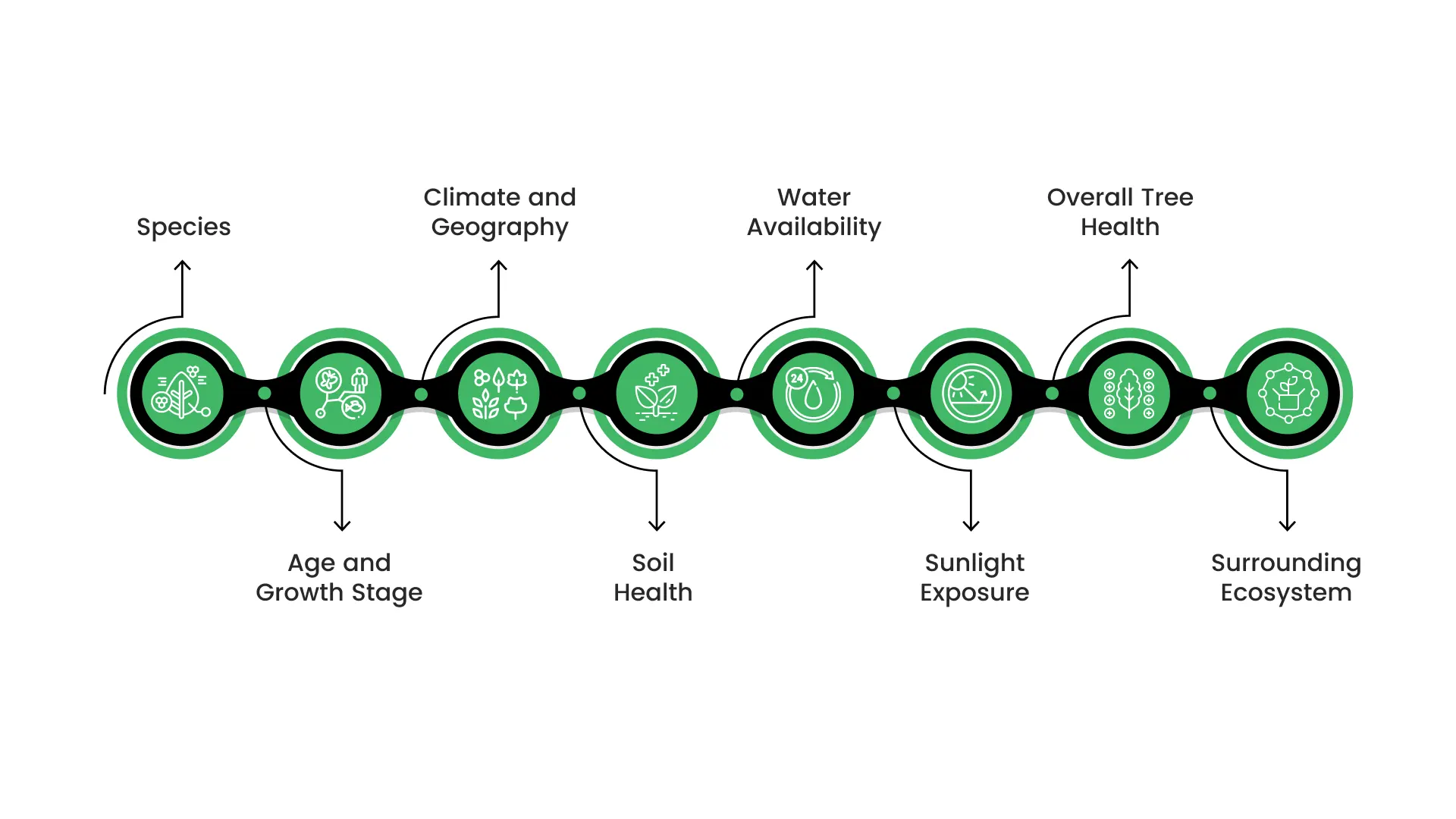
Now that we have a realistic range for how much CO₂ a tree can absorb, it’s important to understand why these numbers vary so widely. Here are a few factors that significantly affect how much CO₂ a tree can absorb:
1. Species
Different species grow at different rates, reach different sizes, and develop distinct wood densities. Fast-growing species, such as poplar or eucalyptus, tend to absorb more CO₂ in their early decades because they rapidly accumulate biomass. In contrast, slower-growing hardwoods, such as oak or beech, accumulate denser wood and ultimately store larger amounts of carbon over their lifetime. Some species, such as mangroves, have unique root systems that store significant amounts of carbon underground, making them particularly valuable for long-term carbon sequestration.
2. Age and Growth Stage
A tree’s age and growth stage also play a major role in how much CO₂ it absorbs. Young, actively growing trees are typically the most efficient at pulling carbon from the atmosphere. During their first 20 to 30 years, they expand rapidly, producing new leaves, branches, and trunk diameter, all of which require substantial carbon input.
As trees mature, their rate of growth slows, resulting in a decrease in their annual CO₂ absorption, even though their total stored carbon continues to increase. Mature and old-growth trees may absorb less carbon each year, but they remain critical carbon reservoirs that contribute to ecosystem stability.
3. Climate and Geography
The climate and growing conditions surrounding a tree have a direct influence on its ability to capture CO₂. Trees in tropical regions often absorb more carbon annually because warm temperatures and consistent sunlight allow them to photosynthesize year-round.
In temperate climates, growth slows during colder months, while in arid or high-altitude regions, limited water and harsh conditions can restrict biomass development. Temperature, humidity, and the length of the growing season all work together to determine how effectively a tree can convert atmospheric carbon into new growth.
4. Soil Health
Trees growing in nutrient-rich, well-structured soil have better access to the water and minerals required for healthy growth, which directly increases their ability to absorb CO₂. Poor soil, whether compacted, eroded, or nutrient-depleted, restricts root expansion and reduces the tree’s ability to build new biomass. Soil microbes and fungi also play a crucial role, forming networks that help trees absorb nutrients more efficiently. Forests with healthy, biologically active soils almost always outperform those with degraded soils in terms of carbon capture.
5. Water Availability
Another critical factor is water availability. Photosynthesis requires a steady supply of water, and trees experiencing drought stress naturally absorb less CO₂. When water becomes scarce, trees slow down their growth, drop leaves, or, in severe cases, go into survival mode, dramatically reducing their carbon uptake.
While some species are more drought-tolerant than others, long-term water limitations almost always lead to lower absorption rates. This makes species selection and proper site evaluation especially important in regions facing water scarcity.
6. Sunlight Exposure
Sunlight exposure also shapes how efficiently a tree absorbs carbon. Trees planted in open areas, where they receive unobstructed sunlight, tend to grow faster and absorb more CO₂. In dense forests, younger or shaded trees may struggle due to limited access to sunlight, which slows their growth and reduces their annual carbon uptake. Positioning, spacing, and canopy structure all affect how much sunlight reaches each tree, influencing its long-term carbon absorption potential.
7. Overall Tree Health
A tree’s overall health and maintenance are equally important. Trees weakened by pests, diseases, poor pruning practices, or physical damage absorb far less CO₂ because they divert energy toward survival rather than growth. Healthy trees, on the other hand, develop more biomass each year, sequestering significantly more carbon. Simple steps, such as proper watering, mulching, pruning, and early-care protection, can dramatically improve a tree’s ability to thrive and absorb carbon over its lifetime.
8. Surrounding Ecosystem
Trees do not grow in isolation; they are part of a larger ecological network. A biodiverse forest supports stronger nutrient cycles, healthier soil, and more resilient growth patterns, all of which contribute to higher carbon storage.
Mixed-species plantings reduce competition for identical resources and create natural checks against pests and diseases, leading to healthier trees overall. This ecosystem-level support can significantly enhance a tree’s ability to absorb and store CO₂, both above and below ground.
How to Measure CO₂ Absorption Over Time
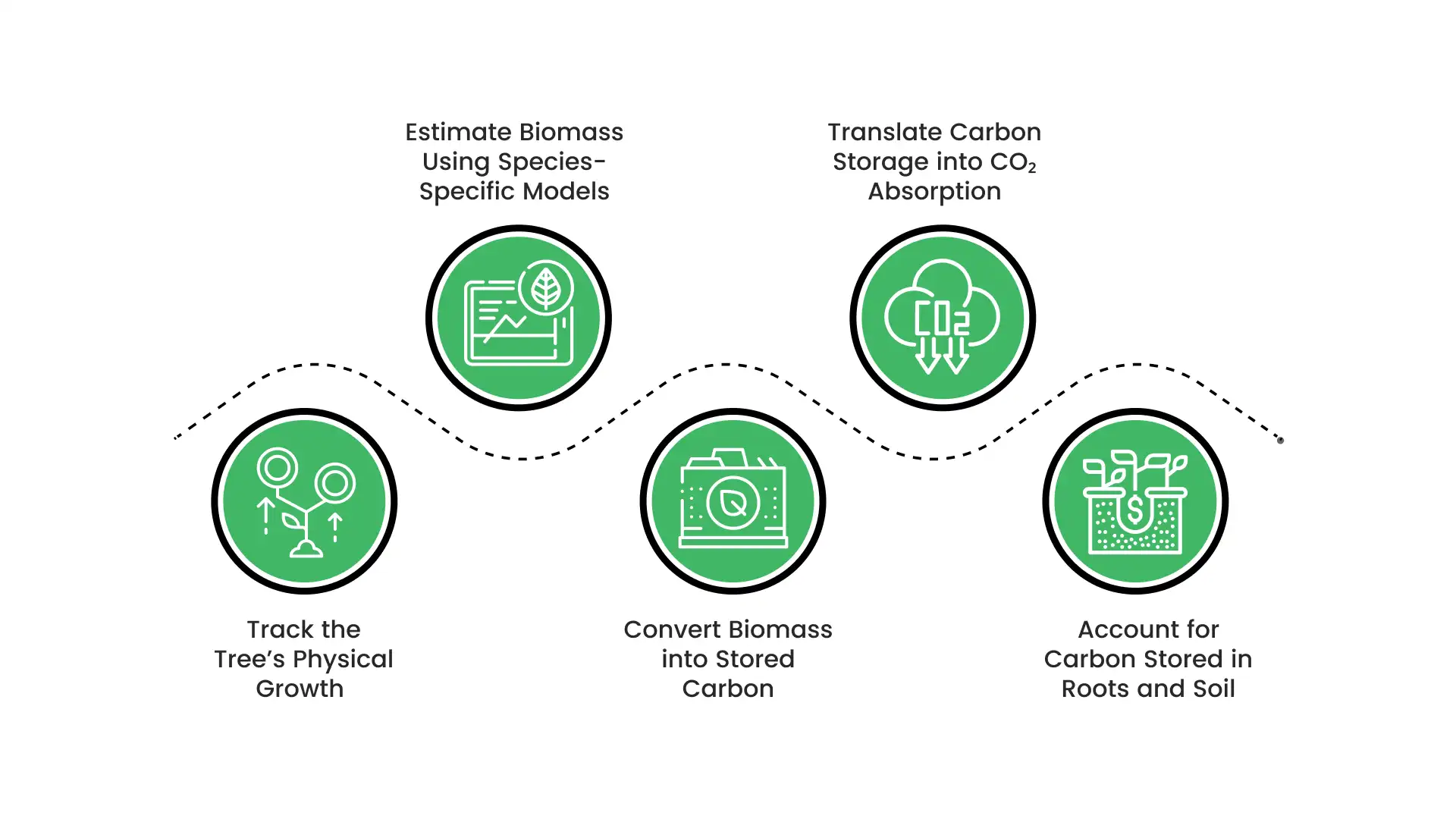
Understanding how much CO₂ a tree absorbs over time comes down to one idea: carbon becomes part of the tree as it grows. Scientists don’t measure the air around a tree; they measure the growth of the tree itself because that growth represents carbon pulled from the atmosphere and stored in living biomass. Here’s how the process works:
Step 1: Track the Tree’s Physical Growth
The starting point is measuring the tree’s diameter at breast height (DBH) — a consistent point on the trunk used worldwide. As the tree thickens, it reflects the amount of new wood added each year. Height is sometimes recorded, too, but the trunk’s diameter is the most reliable indicator of total biomass gain.
Step 2: Estimate Biomass Using Species-Specific Models
Growth measurements are then plugged into allometric equations, scientific models that estimate biomass based on the size of the tree. These models vary by species because each tree grows differently. Using species-specific data helps account for differences in wood density, branching patterns, and natural growth rates.
Step 3: Convert Biomass into Stored Carbon
Once the new biomass is estimated, scientists calculate how much of it is carbon. Roughly half of a tree’s dry mass is carbon captured from the atmosphere during photosynthesis. This step helps translate physical growth into a meaningful measure of how much CO₂ the tree has removed from the air.
Step 4: Translate Carbon Storage into CO₂ Absorption
To understand the climate impact, the stored carbon is converted into CO₂ equivalents. Because CO₂ is heavier than carbon alone, scientists use a molecular conversion factor (3.67) to estimate how much atmospheric CO₂ was captured. This step provides the figure most people look for, how many kilograms of CO₂ a tree absorbs in a given period.
Step 5: Account for Carbon Stored in Roots and Soil
A large part of a tree’s carbon benefit happens below ground. As roots expand and organic matter accumulates in the soil, additional carbon is stored in a more stable form. Although more complex to measure directly, long-term monitoring reveals that healthy trees significantly contribute to soil carbon pools, a crucial factor in long-term climate resilience.
While not exact to the last decimal, this method provides a reliable, science-backed way to understand CO₂ absorption at both the tree and forest level.
How to Maximise Tree-Based CO₂ Uptake
Maximising how much CO₂ a tree absorbs isn’t just about planting more trees; it’s about planting wisely and ensuring the environment around each tree supports long-term, healthy growth. Here are the core principles that make the biggest difference:
1. Choose Species That Thrive in Local Conditions
Trees grow best when they’re planted where they naturally belong. Species suited to the region’s climate, soil, and rainfall absorb CO₂ more efficiently because they face fewer stressors. Native trees also strengthen local biodiversity, build healthier ecosystems, and have higher survival rates, all of which are necessary for sustained carbon storage.
2. Prioritise Diversity Over Monocultures
Mixed-species plantings create healthier, more resilient forests. When different types of trees grow together, they break pest cycles, improve soil structure, and support richer microbial life. This diversity enhances both above-ground and below-ground carbon storage and creates forests that can adapt to changing climate conditions.
3. Invest in Early Maintenance and Care
The first decade of growth shapes the tree’s entire carbon impact. Regular watering, mulching, and protection from damage help young trees grow quickly and steadily. A well-established tree absorbs significantly more CO₂ year after year, while a stressed or neglected tree contributes far less.
4. Support Reforestation and Ecological Restoration
Large-scale reforestation and afforestation projects restore degraded land and rebuild natural habitats, creating carbon sinks far more powerful than isolated plantings. Restored ecosystems support healthier soil, improved water regulation, and stronger forest resilience, all of which boost carbon storage on a landscape scale.
Make Every CO₂ Offset Count with Plantd

Trees don’t just absorb CO₂, they rebuild ecosystems, improve soil health, and strengthen communities. When you plant through Plantd, you’re supporting verified reforestation projects that prioritise long-term forest health rather than one-time planting efforts.
Whether you’re a school, a community group, or an organisation committed to meaningful climate action, your support helps put the right trees in the right places and ensures they grow into healthy, resilient, carbon-absorbing forests that will make a difference for decades to come.
With global reforestation projects, real community impact, and verified results you can track, Plantd turns prevention into progress. Together, we can do more than stop fires; we can rebuild what’s been lost and protect what still stands.
Help grow a healthier forest tomorrow.
Start Planting with Plantd