
How Healthy Forests Support Biodiversity & Water Cycles
When you think of forests, what comes to mind? Most people picture forests as pleasant places for weekend hikes or scenic drives. But forests are so much more than that.
Forests are working systems. Every day, they filter water, store carbon, generate rainfall, regulate temperatures, and support millions of species. Their infrastructure is as critical as power grids or water treatment plants, except they've been doing their job perfectly for millions of years without needing repairs.
The problem is, we've been treating forests like they're optional. And now, as forests disappear at alarming rates, we're starting to see just how much we depend on what they do.
Here's what happens when forests are healthy, why that matters more than most people realize, and what's at stake if we don't protect them.
What Makes a Forest Actually Healthy
Not all forests are created equal. A healthy forest isn't just a bunch of trees standing in the same place. It's a complex ecosystem with specific characteristics that scientists can measure and track.
According to the U.S. Fish and Wildlife Service, healthy forests have four key elements: rich biodiversity with a wide variety of species from all kingdoms of life, varied habitats including meadows, streams, and different tree densities, trees of various ages and sizes from saplings to old growth, and clean water with strong root systems that control erosion.
Biodiverse forests with varied structure are more resistant to disease and catastrophic wildfires. When forests have multiple layers that include tall trees, medium-height trees, shrubs, and ground cover, they create the kind of complexity that nature needs to thrive.
The Role of Biodiversity in Forest Productivity and Ecosystem Resilience
The relationship between biodiversity and what forests can do goes even deeper than most people realize.
Studies examining forests across different regions have found something fascinating. Biodiversity accounts for about half of global forest productivity. That means when forests lose species diversity, they don't just lose those individual species. They lose productivity, carbon storage capacity, and resilience.
It works through multiple mechanisms. Different tree species have different root depths, so diverse forests can access water and nutrients from various soil layers. Some species grow quickly and capture light, while others grow slowly and store carbon for centuries. Certain trees partner with fungi that help other plants absorb nutrients. When you remove one piece, the whole system becomes less efficient.
Research in Germany examined 150 forest plots across different management types. The findings were clear: carbon storage was 32% higher in uneven-aged forests compared to even-aged forests, and older forests with diverse deciduous trees promoted both biodiversity and carbon storage.
What does this mean in practical terms? Every species in a forest is doing something. The woodpecker drilling holes in dead trees creates homes for dozens of other animals. Fungi spreading through soil trade nutrients with tree roots in partnerships millions of years old. Fallen logs rotting on the forest floor become nurseries for new trees while sheltering salamanders and insects that feed birds. When forests lose diversity, they lose these interconnected benefits.
How Do Forests Act as Giant Water Management Systems?
Most people rarely think about where their tap water comes from. At most, they picture a treatment plant or a reservoir on the edge of a city. For millions of people, though, the true source sits far upstream in mountain forests they may never see.
Forests function as natural water infrastructure. The cleaner and healthier they are upstream, the cleaner and more reliable the water that reaches cities downstream.
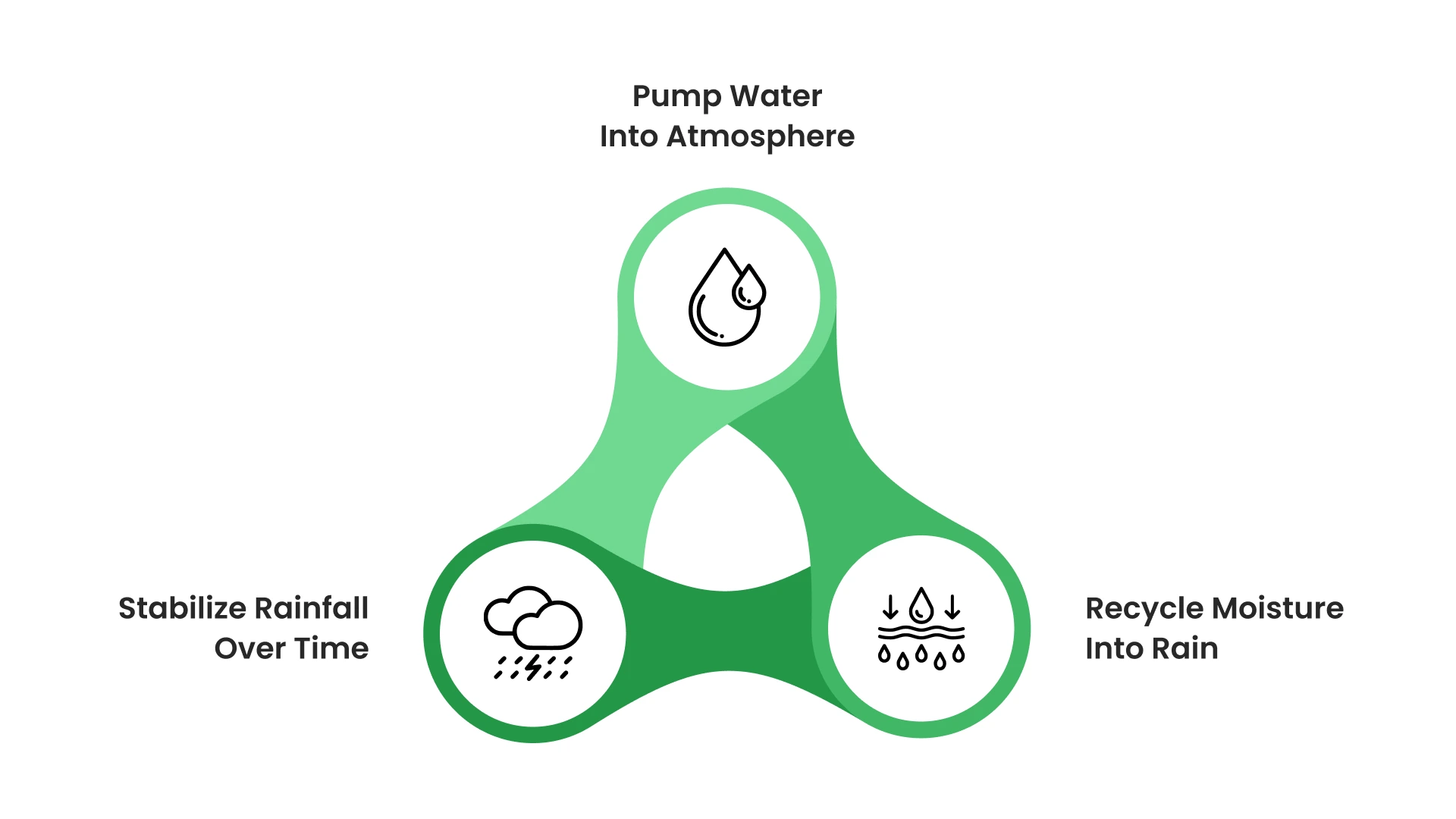
Pump Water Into Atmosphere
Trees do not just absorb water. They actively move it through the atmosphere.
-
Natural Water Pumps: In the southeastern United States, between about 50% and 80% of precipitation that falls on forested land returns to the atmosphere through evapotranspiration. This means that roughly half to most of the water that enters forest ecosystems in this region is cycled back into the air, where it can later form clouds and rain.
-
Moisture Recycling: Water released by trees rises into the atmosphere, forms clouds, and later returns as rain. This process, known as moisture recycling, often delivers precipitation hundreds of miles away from where the water first entered the forest.
Recycle Moisture Into Rain
In large forest systems, moisture recycling becomes a dominant driver of rainfall.
-
Amazon Basin: Evapotranspiration from tropical forests contributes up to 41% of the basin’s mean rainfall.
-
Congo Basin: Evapotranspiration contributes up to 50% of rainfall.
These figures show that forests are not passive landscapes. They actively create the rainfall that keeps entire regions habitable.
Stabilize Rainfall Over Time
Forests also regulate how rain falls over time.
Global research shows that when forests supply at least 50 percent of an area’s precipitation, monthly rainfall variability drops by about 60 percent.
This buffering effect prevents extreme cycles of drought and flood. Stable rainfall patterns are important for agriculture, groundwater recharge, and long-term planning.
Without forests, water systems shift from predictable to volatile.
What Happens When Forests Disappear?
Deforestation breaks these systems in ways that extend far beyond the cleared land.
-
Local impacts: Reduced tree cover leads to less evapotranspiration, lower rainfall, and declining crop yields.
-
Distant consequences: Rainfall does not stop at borders. Loss of forests in one region can reduce precipitation hundreds or even thousands of miles away.
Forests are not just scenery. They are giant, self-regulating water management systems that quietly keep modern civilization functioning.
How Do Forests Regulate the Carbon Cycle?
Everyone talks about carbon these days. Companies promise to be “carbon neutral.” Governments set emission targets. But here's what often gets overlooked: forests are already doing the work.
Research examining global forest carbon potential found that at present, global forest carbon storage is markedly under the natural potential, with a total deficit of 226 Gt in areas with low human footprint, and 61% of this potential could be achieved by protecting existing forests so they can recover to maturity.
That's 226 gigatonnes of carbon that could be pulled out of the atmosphere if we just let forests do what they naturally do. For context, humans emit about 40 billion tonnes of CO2 annually. Protecting and restoring forests could offset a significant chunk of those emissions.
But forests don't just store carbon in tree trunks. Studies of tropical forests in India's Western Ghats found that the average carbon stock was 336.8 Mg C/ha, distributed as 65.5% in live vegetation, 5.5% in detritus, and 29% in soil. Nearly a third of forest carbon sits underground, invisible but critical.
Different forest types store different amounts. For example, tropical forests store carbon in biomass and soil, making them incredibly efficient carbon warehouses. When these forests are cut down, that stored carbon gets released back into the atmosphere, accelerating climate change rather than slowing it.
Ecological and Societal Consequences of Forest Degradation
The consequences of forest loss are no longer theoretical. They are unfolding in real time, reshaping water systems, ecosystems, and human livelihoods worldwide.
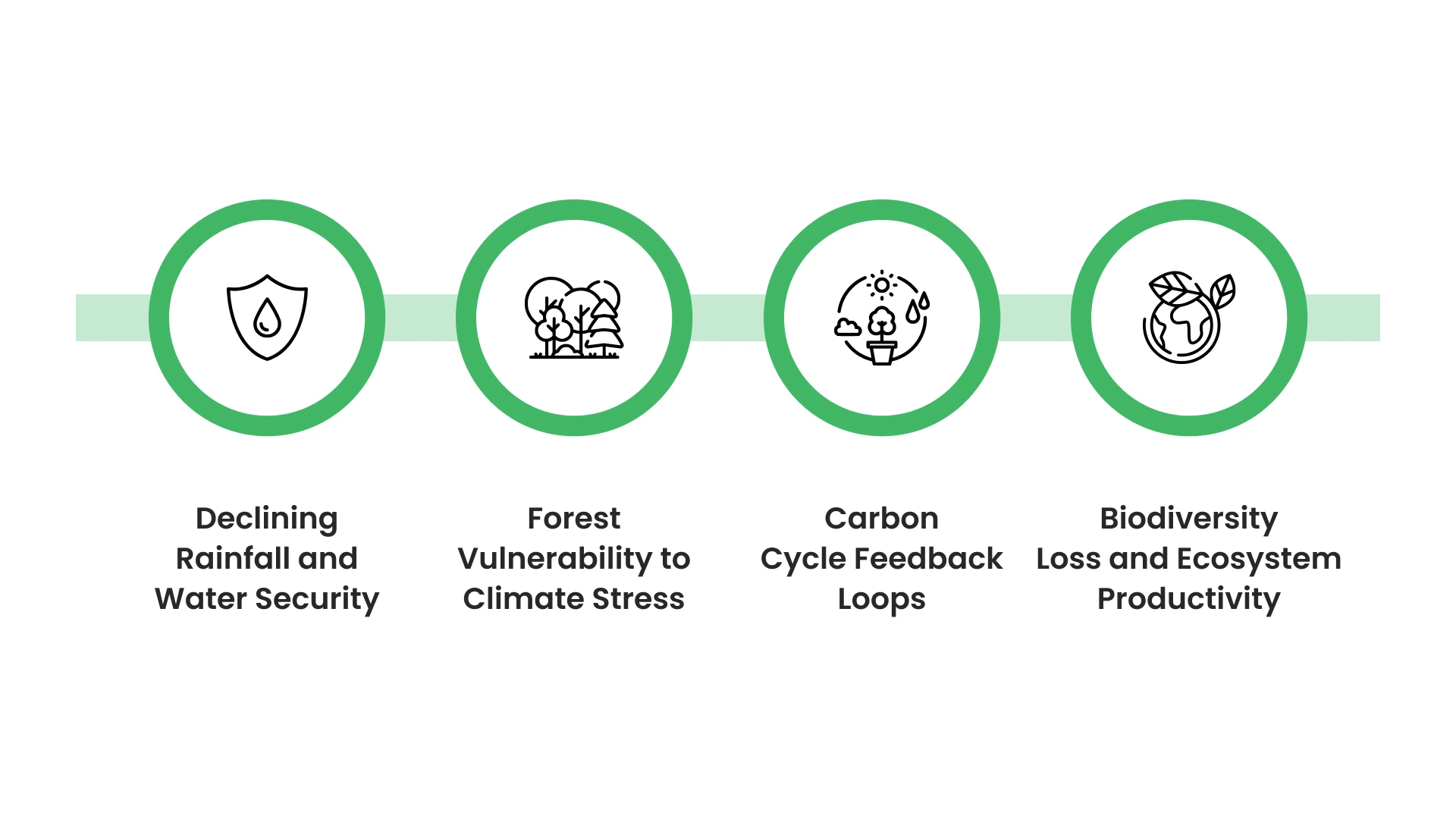
Declining Rainfall and Water Security
When forests disappear, rainfall patterns change rapidly and consistently.
-
Observed precipitation loss: Satellite-based studies show that tropical deforestation leads to large reductions in rainfall. All ten major global satellite precipitation products agree on the direction of the response: less forest cover means less rain.
-
Human impacts: Communities that once depended on reliable rainfall experience growing water scarcity. Farmers who relied on predictable wet and dry seasons face declining yields and repeated crop failures.
Forest Vulnerability to Climate Stress
Forests themselves are increasingly exposed to climate extremes.
-
Rising temperatures and shifting rainfall: Climate models indicate that many forest regions are becoming more vulnerable as temperatures rise and precipitation patterns shift.
-
“Hot droughts”: Some regions now experience hot droughts, periods where extreme heat coincides with reduced rainfall. These conditions push forests beyond their physiological limits and increase tree mortality.
Carbon Cycle Feedback Loops
Forest loss amplifies climate change rather than merely responding to it.
-
Carbon absorption declines: Healthy forests act as carbon sinks, pulling carbon dioxide out of the atmosphere.
-
Carbon release accelerates warming: When forests die or burn, stored carbon is released back into the atmosphere, creating a feedback loop that accelerates global warming and further destabilizes climate systems.
Biodiversity Loss and Ecosystem Productivity
Forest degradation undermines the biological foundations of ecosystem function.
-
Productivity declines: Research shows that biodiversity loss can be a major driver of reduced ecosystem productivity, comparable in impact to elevated carbon dioxide levels or prolonged drought.
-
System-wide consequences: Reduced productivity weakens ecosystem resilience, making forests less capable of recovering from disturbance and less able to provide crucial services such as water regulation, soil stability, and food production.
Protect the Systems That Sustain Life With Plantd

If you’re looking for a concrete way to support healthy forests and the ecosystems they sustain, consider Plantd.
Plantd connects people who care about forests with verified restoration and conservation projects that make measurable differences. Their genuine efforts to restore damaged forests, protect threatened ecosystems, create jobs in local communities, and rebuild the natural infrastructure everyone depends on.
Every action through Plantd supports projects with measurable outcomes, transparent reporting, and local job creation. It’s a straightforward way to turn concern into concrete results that strengthen the natural systems supporting all life on Earth.
Support verified forest restoration through Plantd and be part of rebuilding the living infrastructure that makes human civilization possible.