
What Is Forest Conservation?
Ever wonder what happens to the world when forests disappear? Analysis from Global Forest Watch and the University of Maryland’s GLAD lab shows that 6.7 million hectares of tropical primary rainforest were lost in 2024. That’s not a typo. Every 24 hours, an area of forest larger than the size of a football field disappears every single second.
The consequences go far beyond just losing trees. Since 1990, it is estimated that 420 million hectares of forest have been lost through conversion to other land uses. That's habitat destruction, disrupted water cycles, billions of tons of carbon released into the atmosphere, and entire communities losing their livelihoods.
Forest conservation is the response to this crisis. But what does it actually mean, and why does it matter more than most people realize?
What Forest Conservation Really Means
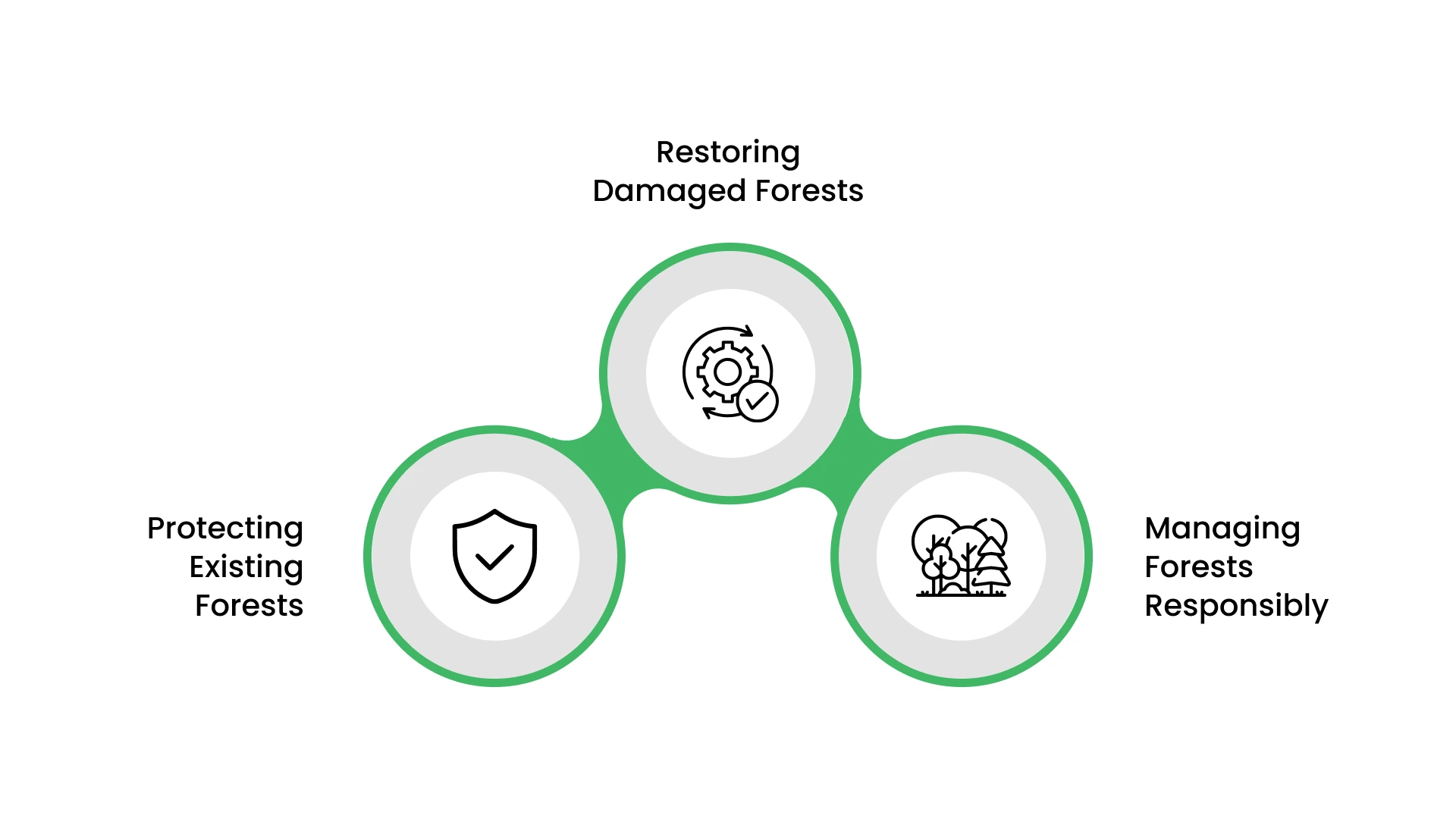
Forest conservation involves maintaining the natural resources within a forest that benefit both humans and the ecosystem. It's not a single action. It's a comprehensive approach built on three interconnected strategies.
-
Protecting Existing Forests
The most effective forest conservation strategy is often the simplest: protect what’s already there. When mature forests get cut down, centuries of carbon storage are released back into the atmosphere. The biodiversity disappears. The water filtration stops. Everything those forests were doing just ends.
-
Restoring Damaged Forests
Around the world, forests have been lost for many reasons. Cities expanded into once-forested lands. Farmlands replaced critical rainforests. Extensive logging destroyed habitats. In many of these places, restoration can reverse the damage, but it requires getting the details right.
-
Managing Forests Responsibly
Here's where forest conservation gets complicated. Many of the world’s natural forests provide wood and fiber products, such as lumber, furniture, and paper, that are critical to people's lives and livelihoods. Of those living in extreme poverty, over 90 percent depend on forests for wild food, firewood, or as part of their livelihoods.
The Biggest Threats to Forests Today
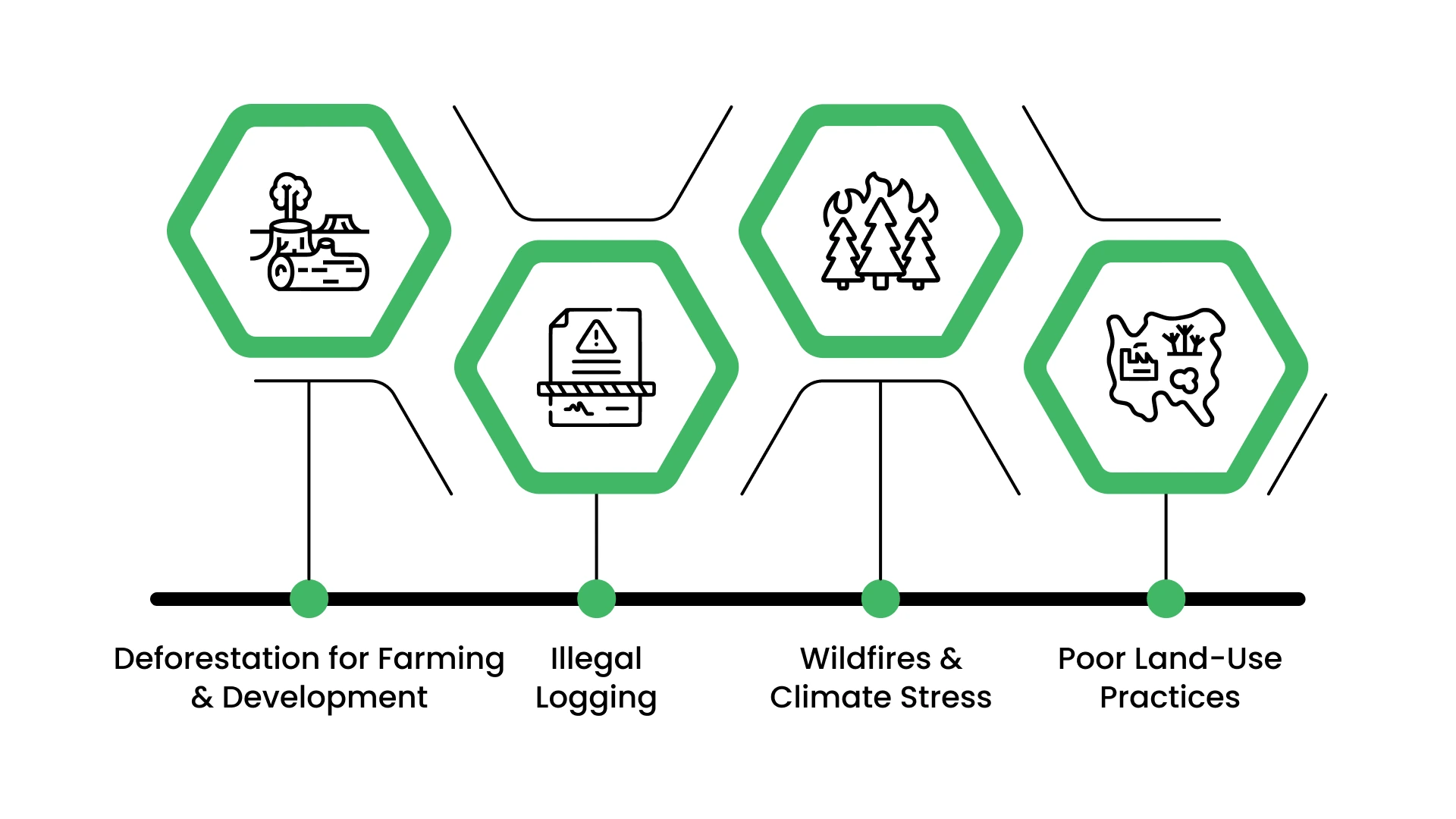
Understanding what's destroying forests helps clarify why conservation matters so urgently.
-
Deforestation for Farming & Development
Production of commodities, including beef, soy, palm oil, pulp, paper, energy, and minerals, is the leading cause of deforestation. Beef production is estimated to be the biggest driver of deforestation worldwide, accounting for 41% of global forest losses. In the Amazon alone, cattle ranching accounts for 80% of deforestation.
This massive habitat loss accounts for about an eighth of global climate emissions, with enormous impacts on the many local and Indigenous communities that rely on these forests. Cities expanding into forest areas compound the problem, converting natural ecosystems into concrete and asphalt.
-
Illegal Logging
Beyond legal commercial operations, illegal logging strips forests without oversight, accountability, or sustainable practices. Organized crime is a top driver of global deforestation, along with beef, soy, palm oil, and wood products. Criminal networks exploit weak governance and corruption to harvest valuable timber, leaving devastated landscapes and impoverished communities behind.
-
Wildfires & Climate Stress
Climate change creates conditions that make forests more vulnerable. Extended droughts weaken trees, making them susceptible to pests and disease. Rising temperatures increase wildfire risk. When forests burn, they release stored carbon back into the atmosphere, creating a dangerous feedback loop that accelerates climate change.
-
Poor Land-Use Practices
Even well-intentioned forestry can harm forests when done poorly. Clear-cutting without regeneration plans, converting diverse forests into single-species plantations, ignoring soil health, and failing to protect water sources all degrade forest ecosystems over time.
How Does Forest Conservation Work in Practice?
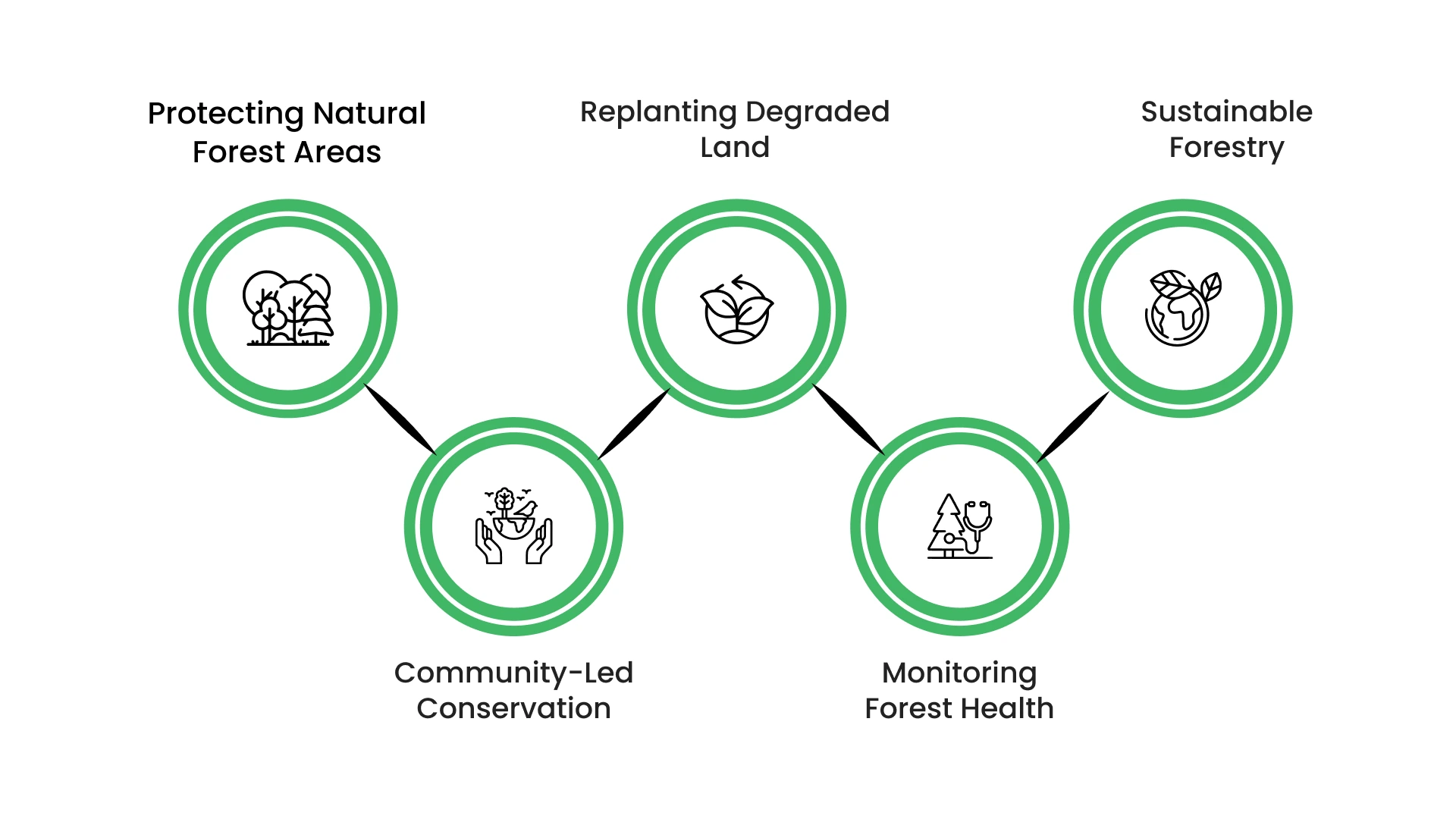
Forest conservation is on-the-ground work happening in communities around the world through specific, measurable actions.
-
Protecting Natural Forest Areas
The Nature Conservancy works with governments, corporations, Indigenous Peoples, and thousands of partners around the world to establish protected areas, secure land rights, and create economic incentives that make forest protection more valuable than forest destruction.
This includes corporate engagement, pushing companies to clean up their supply chains and commit to deforestation-free sourcing. When major corporations change their practices, it shifts entire industries.
-
Replanting Degraded Land
Effective reforestation is far more complex than just planting millions of trees and calling it a day. Research on natural forest regrowth shows that allowing forests to regenerate can absorb up to 8.9 billion metric tons of carbon dioxide from the atmosphere each year through 2050, while still maintaining native grasslands and current levels of food production.
The key is planting the right species in the right locations using methods that give them the best chance of long-term survival. Planting forests with diverse species can help ensure their success. Monoculture tree plantations lack resilience and don't provide the ecosystem benefits that diverse forests offer.
-
Sustainable Forestry
Sustainable forest management includes climate-smart forestry that selects which trees to harvest in ways that maintain forest health, fire management using controlled burns to reduce catastrophic wildfire risk, and pest and pathogen response, protecting forests from invasive species and diseases.
Urban forestry also plays a role, managing trees in cities to maximize cooling, improve air quality, and enhance stormwater management.
-
Community-Led Conservation
Supporting Indigenous communities who have successfully managed forests for generations using traditional knowledge that science is now confirming works remarkably well is essential to effective conservation.
Projects that involve local communities from the start, providing jobs and economic benefits, tend to succeed. Projects that ignore local needs tend to fail. It's that straightforward.
-
Monitoring Forest Health
Technology now allows continuous monitoring of forest health through satellite imagery, drone surveillance, ground sensors, and community reporting networks. This helps identify threats early, track restoration progress, verify conservation claims, and hold bad actors accountable.
How Forest Conservation Helps People and the Planet?
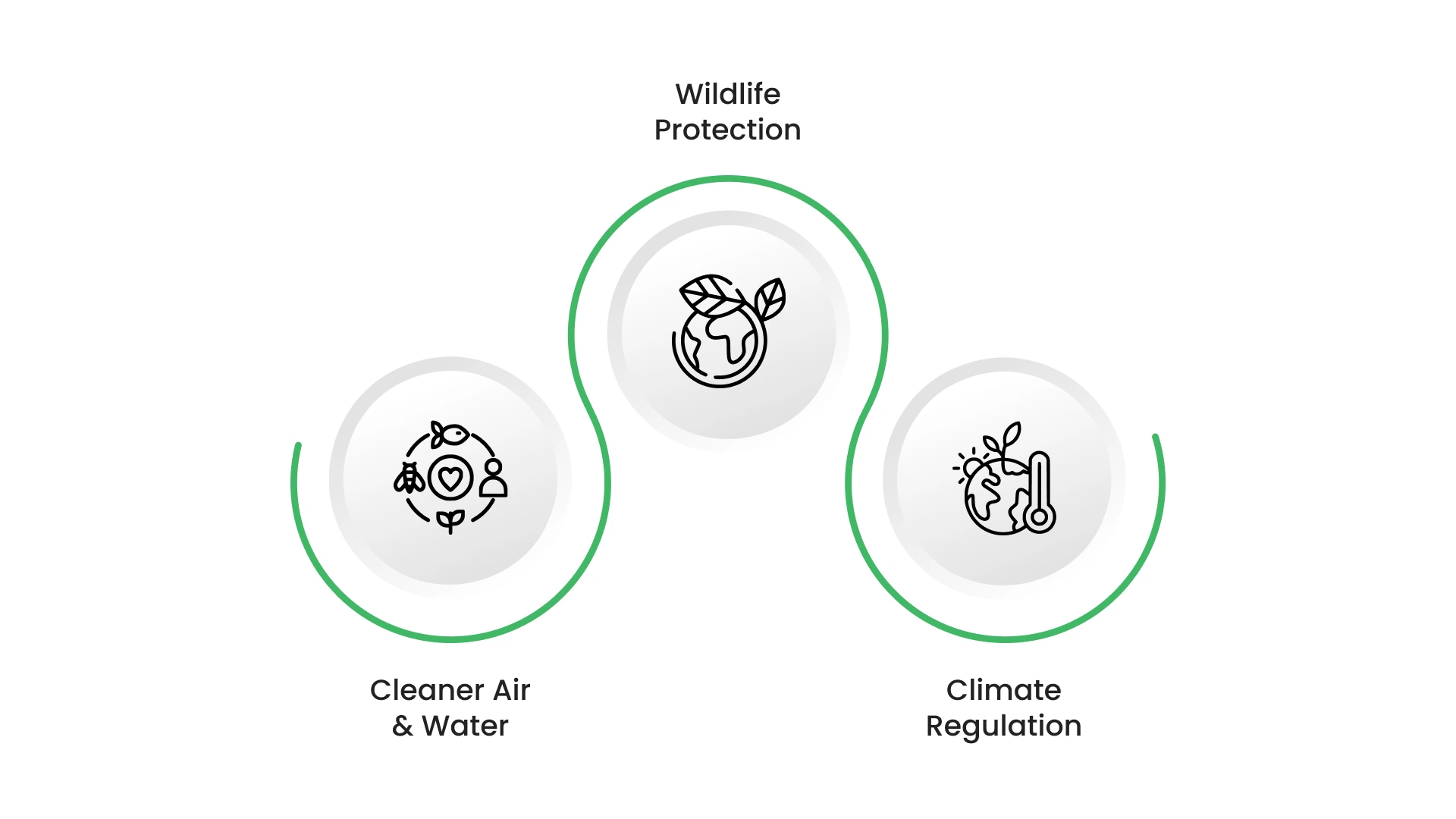
Forest conservation isn't just good for trees. The benefits extend to everyone, whether they live near forests or thousands of miles away.
-
Cleaner Air & Water
Forests help keep water clean by naturally filtering out pollution. For millions of people, the water they drink passed through a forest somewhere upstream, getting naturally purified along the way. Trees also absorb pollutants from the air, improving air quality in both rural and urban areas.
-
Wildlife Protection
When forests disappear, so do the species that depend on them. Forest conservation protects this incredible biodiversity, maintaining the genetic diversity that supports healthy ecosystems and provides resources for medicine, agriculture, and biotechnology.
-
Climate Regulation
Trees are among our most critical natural pathways for absorbing and storing excess carbon to combat climate change. For millennia, trees have pulled carbon dioxide out of the atmosphere and turned it into their bark, wood, and leaves through photosynthesis, the oldest carbon-capture technology on Earth.
Conservation vs. Reforestation: What’s the Difference?
People often use these terms interchangeably, but they're distinct approaches that serve different purposes.
-
Conservation: Protecting What Exists
Conservation focuses on preserving existing forests and keeping them intact and healthy. It's about avoiding deforestation, preventing degradation, and maintaining the ecosystems that are already functioning. The logic is straightforward: a mature forest that's been developing for decades or centuries provides benefits that a newly planted forest won't match for generations.
Protected forests continue to store carbon, support biodiversity, filter water, and provide ecosystem services without interruption. There's no recovery period, no uncertainty about whether planted trees will survive, and no delay in benefits.
-
Reforestation: Restoring What Was Lost
Reforestation means restoring trees to places where they once grew and can grow into healthy forests. This can be done by letting young trees grow back naturally or by planting new seeds or seedlings.
Research led by The Nature Conservancy has shown that in the United States, planting trees on frequently flooded lands, open urban spaces, degraded pastures, and other formerly forested, underutilized areas could capture up to 535 million metric tonnes of carbon dioxide each year. That's massive potential, but it requires decades for those forests to mature into the carbon-storing, biodiversity-supporting ecosystems that old-growth forests already provide.
Protect Forests Through Work You Can Trust with Plantd
Forests are among our most critical natural pathways for absorbing and storing excess carbon to combat climate change. The forests we protect today will filter water, store carbon, regulate climate, and support biodiversity for generations we'll never meet. That’s the kind of investment that compounds over decades and centuries in ways short-term thinking never will.
If you’re ready to move beyond good intentions into measurable action, Plantd offers a straightforward way to support forest conservation work that's transparent, verified, and effective.
Plantd connects people who care about forests with projects that make documented differences. These aren't vague tree-planting campaigns with questionable outcomes. They're targeted efforts to restore damaged forests, protect threatened ecosystems, create jobs in local communities, and rebuild the natural infrastructure that supports all life on Earth.
Every action through Plantd supports projects with transparent reporting, measurable outcomes, and genuine local benefit. It's a direct way to turn concern into concrete results that strengthen the natural systems supporting all life on Earth.
Support verified forest conservation through Plantd and help protect the living infrastructure that makes human civilization possible.