
15 Facts About the Watersheds You Need to Know

You might not see it, you might not think about it, but you’re living in one right now. If you’ve ever wondered: What is a watershed? Consider it as nature’s quiet backstage crew, guiding every drop of water to its final destination. A watershed definition is simple. It is a piece of land where rain, snow, groundwater, and runoff converge into a single point, such as a river, lake, wetland, or ocean.
You can describe what makes up a watershed as a combination of land, soil, slopes, vegetation, streams, and the people and wildlife living within it. Every action that happens on this land eventually becomes part of the water flowing downstream.
And here’s the surprising part. Every square inch of the planet belongs to some watershed area. There is no “outside.” If it rains where you’re standing, that water has a destination, and it carries soil, chemicals, sediment, and nutrients along the way. If you’re exploring facts about the watershed, here’s the biggest one to start with.
Watersheds Are Everywhere, And They’re Huge
The United States is divided into more than 2,200 small watersheds. Globally, some watershed systems are so large they define entire countries:
-
The Amazon River Basin covers 2.7 million square miles
-
The Congo Basin spans nine countries
-
The Mississippi River Watershed drains 31 U.S. states and is one of the largest watersheds in the United States
No matter where a watershed is located, it shapes the way water moves across ecosystems, cities, farms, and forests. Watersheds provide more than 60 percent of the world’s drinking water, support global agriculture, and sustain over 80 percent of terrestrial wildlife.
Yet even though they support life at every scale, these water systems face rising threats from pollution, deforestation, extreme weather, and rapid land development.
Understanding “what is a watershed” and how it works helps us protect it. If you’ve ever looked at a diagram of a watershed, you’ll notice how water moves downhill, collecting pollutants or nutrients before reaching major water bodies. The more you learn, the easier it becomes to change daily habits that protect these natural systems.
To help you better understand. Here’s a neatly labelled diagram of a watershed.
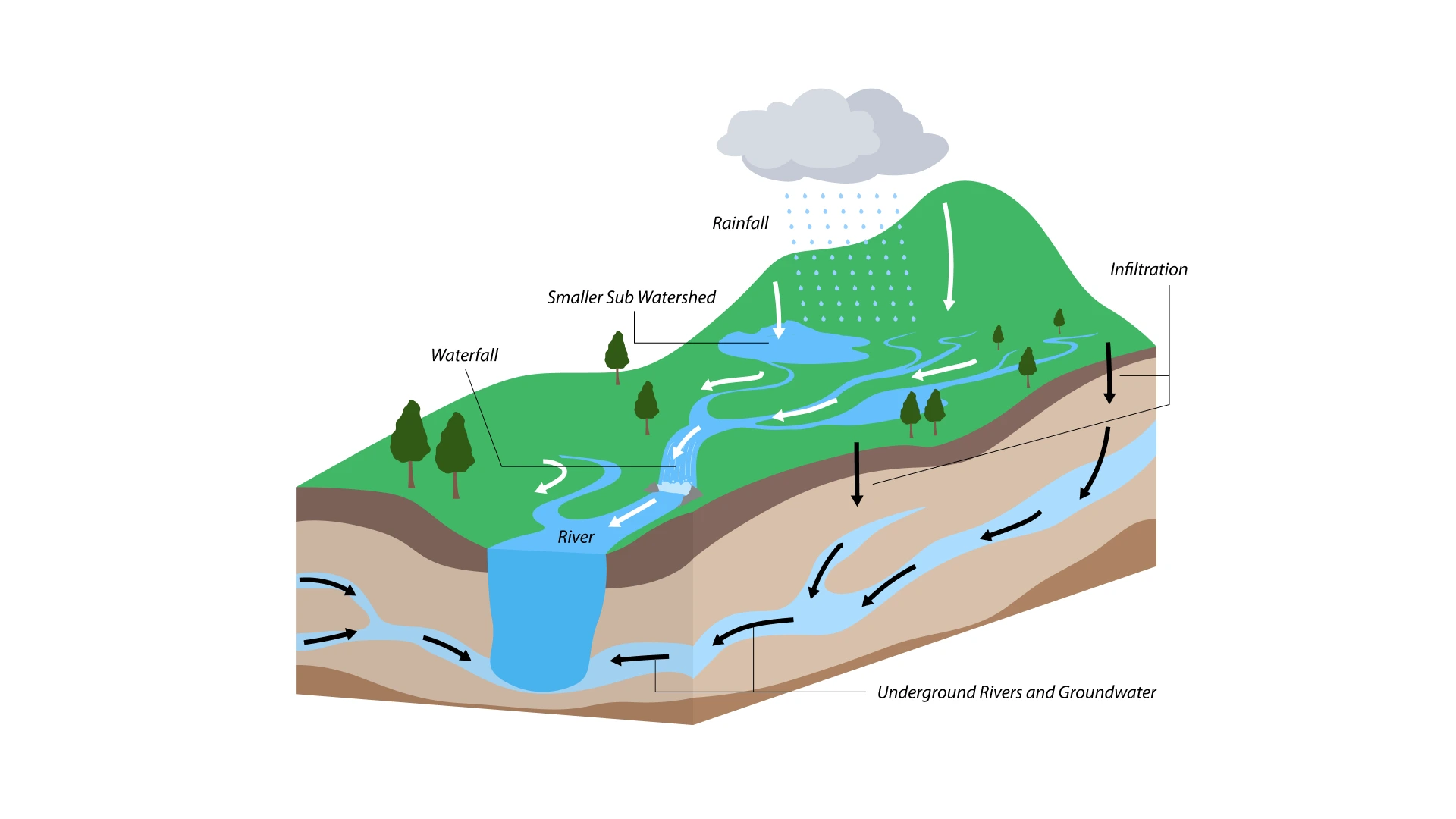
Now that you know the fundamentals, next, let’s explore foundational facts about the watershed.
15 Facts About the Watersheds You Need to Know
Here are the must-know facts about the watersheds that shape our rivers, farms, forests, and drinking water. These insights will help you understand why protecting them matters for every community.
1. Every Place You Stand Belongs To A Watershed
There is no such thing as being “outside” a watershed. All water, from melting snow to driveway runoff, flows into a shared drainage basin. This is one of the most fundamental facts about the watershed, as many people are not aware of it.
2. Watersheds Range From Tiny Neighborhoods To Massive Continents
Some cover a few blocks, while others, such as the Mississippi River Basin, span more than one million square miles. Together, these systems influence entire climates and economies.
3. Over Half The World’s Drinking Water Comes From Watershed-Fed Rivers
Clean tap water depends on healthy watershed area conditions. Once polluted, the damage is difficult and expensive to reverse.
4. Healthy Watersheds Naturally Reduce Flooding
Wetlands, forests, and natural soils slow down rushing water, much like sponges absorb rain. When these areas are replaced with concrete, floods worsen.
5. Watersheds Are Vital Wildlife Corridors
More than 80 percent of terrestrial animals depend on watershed habitats for shelter, breeding, and food.
6. Forested Watersheds Help Regulate Rainfall
Trees influence temperature, moisture, and local rain cycles. When forests disappear, watersheds lose their natural stability.
7. Pollution Moves Through Watersheds Like A Conveyor Belt
Even tiny pollutants like fertilizers or microplastics travel downstream, magnifying water quality issues.
8. Point-Source Pollution Is Easier To Track
Factories and discharge pipes are identifiable, but they are only a fraction of the problem.
9. Nonpoint-Source Pollution Is The Leading Cause Of Water Degradation
Runoff from farms, construction sites, parking lots, suburbs, and poorly maintained septic systems carries contaminants directly into watersheds. The EPA estimates that nonpoint-source pollution affects over 30 percent of impaired water bodies in the United States.
10. Soil Health Determines Water Health
When soil erodes, it carries chemicals and sediment into streams, reducing oxygen levels and harming fish.
11. Wetlands Act As Nature’s Water Filters
A single acre of wetland can hold hundreds of thousands of gallons of floodwater and cleanse runoff before it reaches rivers.
12. Groundwater And Watersheds Are Interconnected
Surface pollution eventually seeps into aquifers. Nearly half of U.S. drinking water comes from groundwater linked to drainage basin systems.
13. Recreation Relies On Clean Watersheds
Fishing, boating, swimming, and wildlife tourism contribute more than $450 billion to the U.S. economy annually.
14. Climate Change Is Reshaping Watershed Behavior
Floods, droughts, and irregular rainfall patterns are disrupting the flow of water through basins worldwide.
15. Everyday Choices Protect Your Watershed
Simple habits like reducing plastic use, picking up pet waste, planting native vegetation, and limiting lawn chemicals help keep pollutants out of rivers and lakes.
If you’re still gathering more facts about the watershed, know this: watershed protection begins at home, but its impact travels miles downstream.
How Watersheds Shape Communities, Cities, & Climate
Watersheds are more than lines on a map. They shape how cities develop, how farms grow food, and how communities receive clean drinking water. Once you understand “what is a watershed?” and “how it functions?”, it becomes clear how deeply it influences everyday life.
A healthy watershed supports entire regions. Forests stabilize slopes, wetlands soften floods, and clean streams fuel recreation, agriculture, and local economies. When a single part of the watershed area is damaged, the whole system feels it. Soil erodes faster, rivers grow cloudy, wildlife loses habitat, and water treatment becomes more expensive.
At the center of it all is the land itself. When you describe what makes up a watershed, you’re looking at a living network where every element matters. Soil absorbs rainfall, grasslands filter pollutants, forest roots hold hillsides together, and tributaries feed major river basins downstream.
Consider the Mississippi River Basin. As one of the largest watersheds in the United States, it powers agriculture, trade, and ecosystems across the country. Yet fertilizer runoff from upstream states travels straight into the Gulf of Mexico, creating one of the largest marine dead zones on the planet. What starts in neighborhoods and fields thousands of miles away ends up reshaping entire ocean systems.
Watersheds are that interconnected.
This is why environmental planners rely on watershed diagrams when designing cities and infrastructure. They help predict water flow, pollution pathways, and future risks. But planning alone cannot protect these systems. When forests thin, soils degrade, or runoff spikes, the watershed becomes more vulnerable, no matter how well-designed the infrastructure is.
The good news is that safeguarding watersheds doesn’t begin with sweeping overhauls. It starts with understanding how water moves through your home, your neighborhood, and your region, and with small daily choices that keep contaminants out of the flow.
Today, it can go even further through restoration efforts that rebuild forest cover and strengthen the natural systems every watershed depends on.
How Can You Help Protect the Watersheds?
Healthy watersheds depend on healthy forests. When trees are lost to fires, development, or climate shifts, the land loses its ability to absorb rainfall, filter pollutants, and retain soil. This is where support from individuals, teams, and communities makes a real difference.
Plantd helps close that gap.
Through reforestation, habitat restoration, and community-led planting projects, Plantd strengthens the landscapes that watersheds rely on. And you are not limited to fundraising for forests alone. Whether you are raising money for a school trip, a sports team, a nonprofit project, or a community initiative, you can run your fundraiser through Plantd and still contribute to restoring degraded land and rebuilding natural water systems.
Every campaign plants real trees and supports verified global projects that enhance soil health, improve water quality, and promote long-term ecosystem stability.
Your everyday choices protect your watershed at home. Your fundraising efforts can help protect watersheds worldwide.
Protect the Watersheds That Help Sustain a Green Earth with Plantd
Every one of these facts about the watershed points to the same truth. Rivers, lakes, wetlands, and coastal ecosystems cannot thrive without forests. When trees vanish, soil erodes, streams become polluted, and entire water networks collapse.
With Plantd, you can help restore the forested systems that keep watersheds alive. Each tree planted strengthens soil, filters runoff, rebuilds habitats, and stabilizes waterways that supply drinking water, farms, wildlife, and communities.
Your contribution does more than plant a tree. It safeguards the water you rely on every day.
With verified global projects, transparent tracking, and visible ecological impact, Plantd helps you turn simple actions into long-term watershed protection. Together, we can rebuild forest cover, restore water pathways, and give every watershed the chance to thrive again.