
Understanding How Trees Clean the Air & Serve as Nature’s Air Filter

Every time you breathe in, you take in thousands of invisible particles and gases. In fact, about 36% of people worldwide are exposed to PM2.5 concentrations higher than the lowest recommended limit of 35 μg/m³. These particles are small enough to slip into the bloodstream and damage the lungs over time.
You don’t need to live near a highway or industrial zone to feel the effects. PM2.5 pollution moves freely through cities and suburbs, settling into the places we spend most of our day. For many people, this shows up as headaches, irritated breathing, lingering coughs, or long-term health risks that quietly build year after year.
This is where trees make a measurable difference. Long before air purifiers or filtration systems existed, trees were already releasing cleaner air back into the environment. In this blog, we’ll break down exactly how trees do this and why they remain one of the most reliable tools we have for improving air quality.
How Do Air Pollution and the Air Quality Index Affect Human Health?
Breathing clean air isn’t guaranteed for many communities. Poor air quality affects long-term health, strains local ecosystems, and reduces visibility in the places people live and work. The Air Quality Index (AQI) helps us understand how polluted the air is on any given day, but the real concern lies in what those pollutants do once they enter the body.
Fine particulate matter, especially PM2.5, is strongly linked to a wide range of health problems. These particles are tiny enough to travel deep into the lungs and even enter the bloodstream. Over time, exposure can contribute to bronchitis-like symptoms, cardiovascular issues, high blood pressure, changes in cognitive development in children, and increased risk of early death. Researchers have also connected long-term PM2.5 exposure with higher chances of glaucoma, heart failure, and neurological impacts.
Different pollutants carry different risks:
-
PM2.5: These fine particles create the hazy skies many people recognize. Once inhaled, they can trigger inflammation in the lungs and increase the risk of chronic respiratory and cardiac conditions.
-
SO₂ and NO₂: These gases irritate the respiratory system and can worsen asthma. They also react in the atmosphere to form additional particulate pollution and contribute to acid rain.
-
Ground-level ozone: When breathed in, ozone can reduce lung function and aggravate respiratory diseases. It also harms sensitive plants during key growth periods.
-
Carbon monoxide (CO): In enclosed or poorly ventilated spaces, CO can become dangerous quickly. It prevents oxygen from reaching vital organs and can be fatal at high levels.
Understanding the AQI and what it represents helps people make informed decisions on days when air quality dips. But long-term solutions depend on reducing pollution at its source and supporting natural systems, like trees, that help filter and improve the air we rely on every day.
The Basic Chemistry of Trees: Photosynthesis and Oxygen Production
Trees convert air into clean breathing space through one of nature’s most important processes: photosynthesis. Here’s how it works in simple terms.
A tree’s leaves absorb carbon dioxide (CO₂) from the air, water from the roots, and sunlight through its chlorophyll. Inside the leaves, the tree uses sunlight to turn CO₂ and water into glucose, which helps it grow, and oxygen, which it releases back into the air.
This process helps the tree grow and actually removes one of the major pollutants affecting both climate and air quality: CO₂. While CO₂ isn’t immediately toxic in the way some gases are, its accumulation in the atmosphere drives warming, which indirectly worsens air pollution and respiratory issues.
To give you a sense of scale, a mature tree can absorb roughly 48 pounds of CO₂ per year, depending on species, size, and growing conditions.
Understanding this basic chemistry shows us why trees are vital to the air we breathe and the climate we depend on.
How Do Trees Absorb Harmful Gases?
Here’s how trees absorb the harmful gases:
-
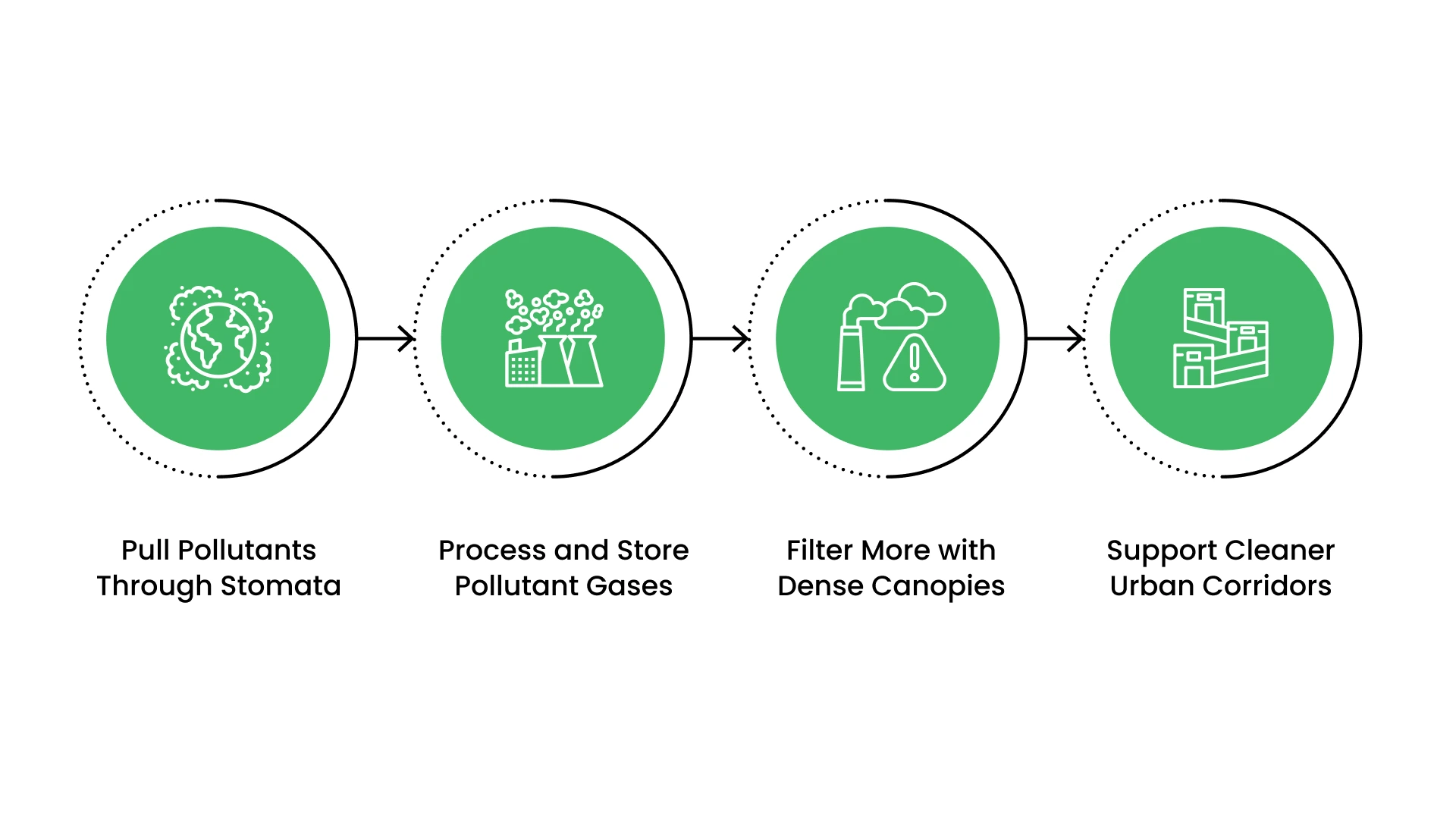
Pull Pollutants Through Stomata: Trees’ leaves contain tiny openings called stomata that function like miniature gateways for gas exchange. When a tree “breathes,” these pores draw in surrounding air filled with CO₂ as well as pollutants like nitrogen dioxide (NO₂), sulfur dioxide (SO₂), and ozone (O₃).
-
Process and Store Pollutant Gases: Once these gases enter the leaf, the tree either breaks them down through internal chemical reactions or safely stores them within its tissues. This prevents the pollutants from re-entering the atmosphere, creating a quiet, continuous cleaning cycle throughout the growing season.
-
Filter More with Dense Canopies: Certain species excel at this process. Trees with broad canopies and dense leaf structures, such as oaks, maples, and many evergreens, contain more stomata and greater leaf surface area, allowing them to absorb larger amounts of harmful gases over time.
-
Support Cleaner Urban Corridors: Urban planners often plant these high-performing species in busy zones, especially near traffic-heavy roads, school areas, and commercial districts. Their ability to reduce NO₂, SO₂, and vehicle-related emissions makes them valuable in areas where people breathe the effects of air pollution every day.
While trees can’t eliminate every pollutant we produce, they significantly improve the surrounding air. Their natural gas-absorbing abilities act as a protective buffer in communities, offering measurable benefits for the people who live, walk, study, and work nearby.
How Do Trees Filter Particulate Matter?
Beyond absorbing gases, trees also help clean the air by capturing particulate matter, the tiny dust, soot, and smoke particles that are harmful to breathe. These particles don’t get absorbed into the leaf the way gases do. Instead, they settle onto the tree’s surfaces, such as leaves, needles, bark, and even small branches.
This “catching” process is important because it keeps the particles out of the air we inhale. The rougher and more textured a tree’s surface is, the more particles it can trap. That’s why evergreens, with their dense needles and year-round foliage, tend to collect more particulate matter than smooth-leaved species.
The story doesn’t end there. When it rains or when morning dew forms, many of these trapped particles wash off naturally. They then move into the soil or mix with stormwater, where they break down or settle safely. This cycle reduces the amount of pollution floating in the air during dry periods, especially in cities where particulate matter levels can climb quickly.
Trees won’t remove every particle, but they consistently make the surrounding air cleaner, especially in high-traffic areas and regions prone to dust or wildfire smoke.
Indirect Air-Cleaning Mechanisms of Trees
Beyond absorbing pollutants, trees influence the air we breathe through powerful indirect processes that often go unnoticed.
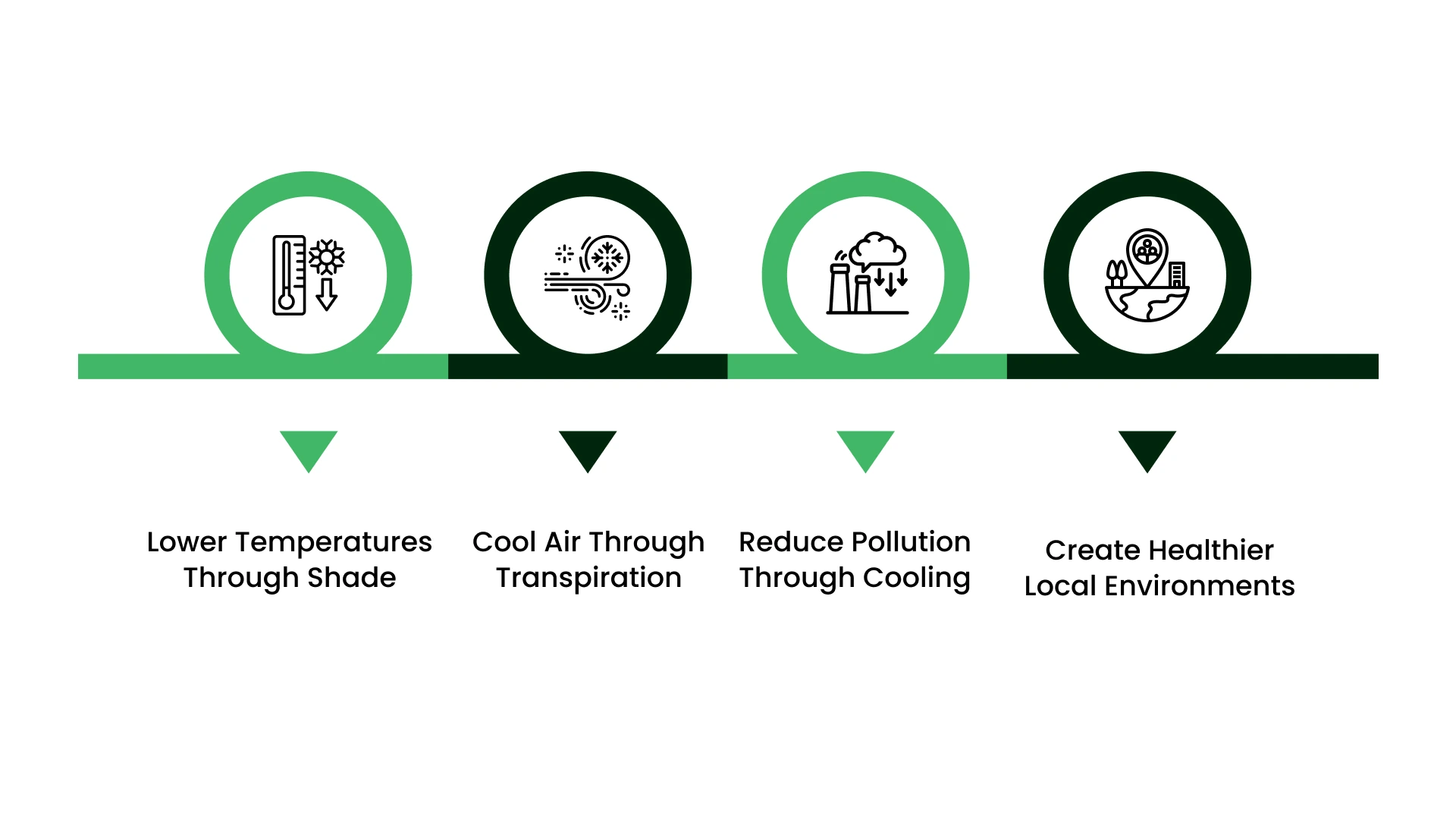
Lower Temperatures Through Shade
Trees reduce surrounding temperatures by blocking direct sunlight, especially in cities where asphalt and concrete absorb and radiate heat. Cooler neighborhoods rely less on air conditioning, which cuts emissions from power plants and reduces pollutants like nitrogen oxides and sulfur dioxide, major contributors to smog and respiratory issues.
Cool Air Through Transpiration
As trees release water vapor through their leaves, they naturally cool the air around them. This drop in temperature slows the formation of ground-level ozone, a harmful pollutant that spikes on hot, sunny days and affects breathing and lung function.
Reduce Pollution Through Cooling
These temperature-lowering effects play a bigger role than most people realize. By keeping neighborhoods cooler, trees indirectly reduce energy demand, lower emissions, and help slow the chemical reactions that worsen air quality.
Create Healthier Local Environments
Communities with stronger tree cover experience fewer heat-related illnesses, better overall air quality, and reduced energy costs. Trees protect people not only by removing pollutants from the air but also by moderating the local climate in ways that make daily living safer and healthier.
Factors That Influence How Well Trees Clean the Air
Not all trees clean the air in the same way or with the same efficiency. Several factors determine how effective a tree will be at absorbing gases, trapping particles, and improving the air around it. Understanding these factors helps choose the right trees for the right places.
Here are some major influences:
-
Tree species: Some species have more leaf surface area, deeper roots, or more stomata, all of which increase their air-cleaning potential.
-
Tree size and age: Mature trees can filter far more air than young ones because they have larger canopies and more developed structures.
-
Leaf type: Rough, textured, or evergreen foliage traps more particulate matter than smooth or seasonal leaves.
-
Location: Trees planted near roads, industrial areas, and dense neighborhoods help reduce pollution where it’s generated.
-
Health and maintenance: Healthy trees absorb more pollutants. Stress from drought, pests, or poor soil reduces their ability to clean the air.
-
Climate conditions: Temperature, humidity, rainfall, and sunlight all affect how actively a tree can perform photosynthesis and gas exchange.
While planting new trees is important, protecting existing mature trees often has the biggest immediate impact. These established trees are already doing the heavy lifting, absorbing pollutants and helping stabilize local air quality every single day.
Support Air-Purifying Forests with Plantd

Understanding how trees purify the air is important, but real change comes when that knowledge turns into action. If you want a direct, meaningful way to improve the air we all depend on, supporting reforestation and urban tree planting through Plantd is one of the most effective steps you can take.
Plantd focuses on restoring and protecting forests and tree-rich ecosystems that naturally improve air quality. These projects absorb pollution, store carbon, cool surrounding neighborhoods, support biodiversity, and create healthier living conditions for nearby communities. Every tree planted becomes part of a long-term solution to cleaner air and a more stable climate.
Every contribution goes toward scientifically backed, on-the-ground work that improves air quality, protects ecosystems, and supports local jobs. Plantd makes it easy to turn concern about pollution into meaningful environmental action.
Take the next step. Help give every community cleaner air to breathe.