


You’re booking a flight. You get to the last page, and there it is, a small checkbox asking if you’d like to offset your emissions by planting a tree. It costs less than your in-flight coffee. You tick it, the guilt eases a little, and you move on.
But does it actually do anything?
Honestly, that’s the question most people never stop to ask. Carbon offsets through tree planting have become so normalized that we either dismiss them as greenwashing or accept them without a second thought. Neither is particularly useful.
But here is the thing: trees really do absorb carbon. But whether the offset you just paid for translates into any real climate impact depends entirely on things you never get to see: which trees were planted, where, how they were managed, and whether anyone is actually checking.
In this blog, we’ll break down how carbon offsets through tree planting actually work, the science behind why trees are such powerful carbon absorbers, where these programs can go wrong, and how to spot an offset that’s genuinely worth your money.
Most people have heard the term thrown around, but if you asked them to explain it in plain English, you’d get a lot of vague hand-waving. So let’s start from the beginning.
At its core, a carbon offset is a trade. You’re producing carbon emissions that you can’t, or rather, you haven’t yet found a way to eliminate. So instead, you pay for an activity somewhere else in the world that either removes an equivalent amount of carbon from the atmosphere or prevents it from being released in the first place. The two cancel each other out, at least in theory.
One carbon offset credit equals one metric ton of CO₂ either removed or avoided.
Tree planting is one of the most common ways this gets done, but it’s not the only one. Offset projects also include capturing methane from landfills, protecting existing forests from clearing, or funding renewable energy in regions that would otherwise rely on coal. Tree planting tends to dominate the conversation because it's tangible; people can picture it, which makes it easier to sell and easier to trust.
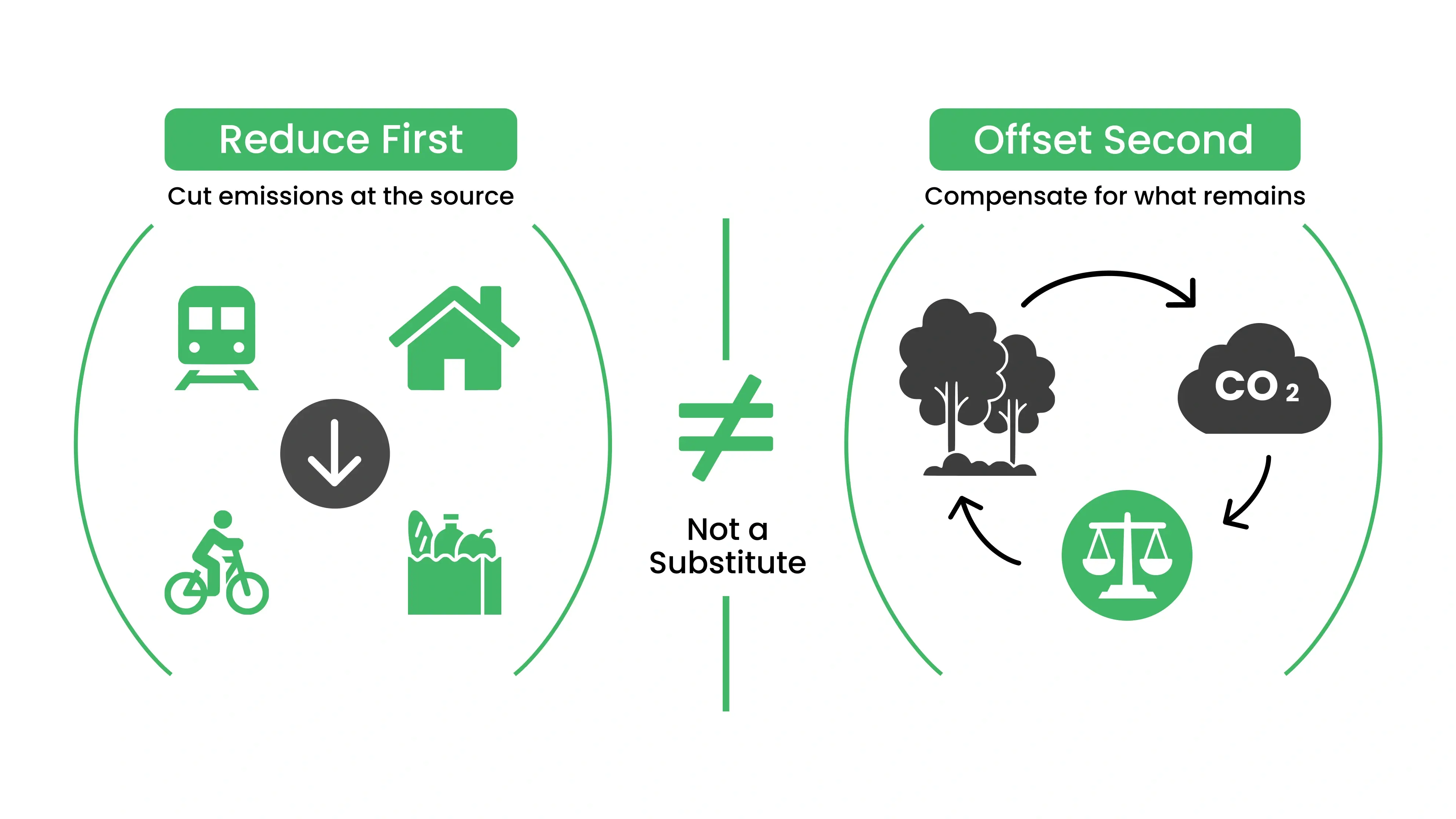
Carbon offsets and carbon reductions are not the same, and mixing them up is where many people and companies go wrong.
Carbon reduction means cutting emissions directly at the source. Taking the train instead of flying, switching to cleaner energy at home, changing your diet, and buying less. These actions prevent carbon from entering the atmosphere in the first place. That's always the more effective move.
Carbon offsetting works differently. Instead of preventing emissions, it compensates for them by funding an activity elsewhere that removes or avoids an equivalent amount of carbon. The idea is that the net impact on the atmosphere balances out.
The problem is when offsetting is used as a substitute for reduction rather than a complement to it. A company that keeps emitting at the same rate but buys credits to appear carbon neutral isn’t solving anything; it’s just doing accounting.
The reason the order matters is simple: no amount of tree planting can absorb what we're currently putting out at scale. So the goal isn’t to offset your way out of the problem. It’s to reduce as aggressively as you can, and use offsets responsibly for what remains. When they’re used that way, they genuinely count.
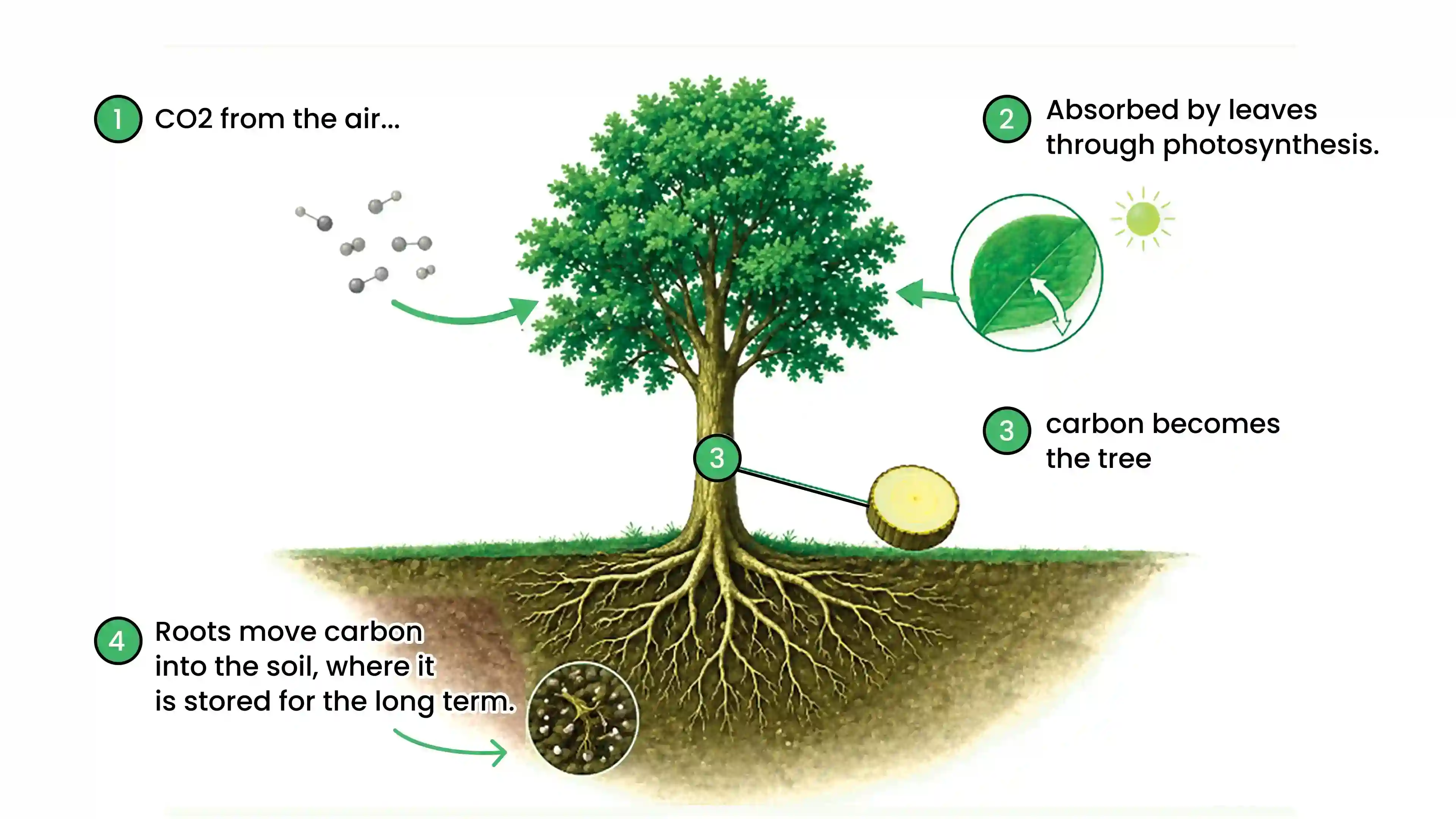
Trees absorb carbon dioxide through photosynthesis; they take it in from the air and use it to grow. The carbon doesn’t disappear; it becomes the tree itself. The trunk, the branches, the roots, the leaves, all of that physical mass is largely built from carbon pulled straight out of the atmosphere.
A single mature tree can absorb up to 22 lbs of CO₂ per year in its first 20 years of growth. A typical hardwood tree absorbs around 20 kilograms of carbon annually, and over 40 to 50 years, that adds up to roughly 1 metric ton of carbon sequestered. And it’s not just stored in the tree above ground. Roots transfer carbon into the soil, where it can remain locked away for a very long time through interactions with microbes and organic matter.
That said, not all trees sequester carbon at the same rate, and not all forests work the same way. A young, actively growing forest is a carbon sponge. An older, more mature one is closer to carbon-neutral. Trees are dying and being replaced at roughly the same rate, so carbon is cycling in and out rather than accumulating. The real sequestration power lies in growing forests, not in those that have already reached equilibrium.
A young tree is essentially consuming enormous amounts of energy to build itself. A mature tree is valuable and still standing, but its heavy carbon-absorbing work is largely behind it.
This is why the type, age, and location of trees in any offset project matter so much. It’s not just about how many trees get planted. It's about whether those trees are actually in a position to do meaningful carbon work over time.
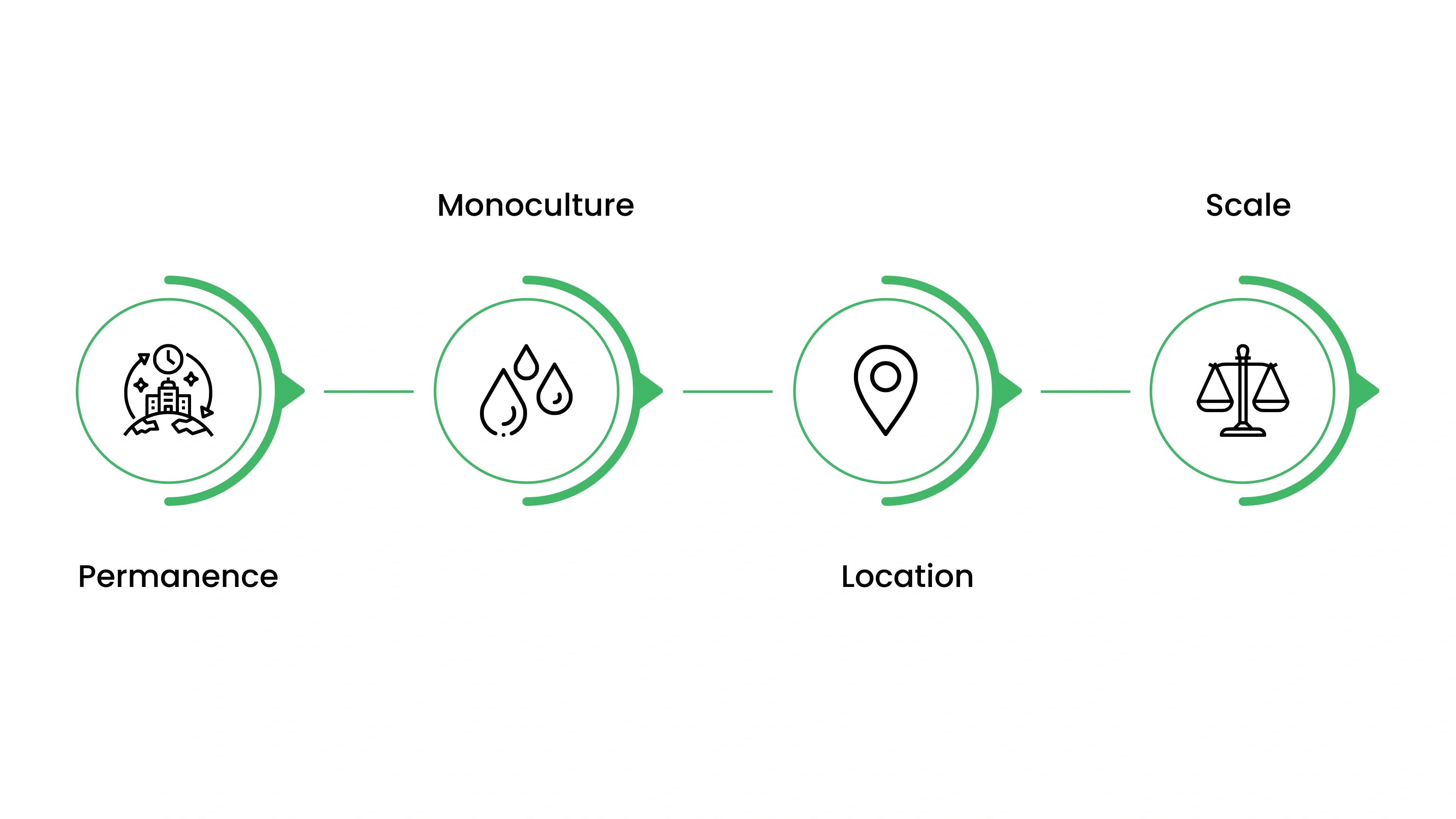
While tree planting is one of the most powerful offset tools we have, there are a few ways it can go wrong:
A tree only stores carbon for as long as it’s standing. If it burns in a wildfire, gets cut down, or dies and decays, that carbon returns straight to the atmosphere. This is one of the most underappreciated risks in tree-based offsetting. A project might look excellent on paper in year one and be largely undone by year ten. Protecting existing forests is just as critical as planting new ones, for exactly this reason.
Planting fast-growing, non-native species in rows might generate impressive carbon numbers quickly, but it often creates more problems than it solves. Eucalyptus and pine plantations, for example, can deplete local water sources, reduce biodiversity, and leave forests more vulnerable to pests and disease. Globally, tree plantations tend to favor a narrow set of species valued by the timber and paper industries, resulting in landscapes that don't function like real forests and don't support the ecosystems that real forests do.
Where a tree is planted changes everything. Trees in tropical regions sequester significantly more carbon than those planted in northern or southern latitudes, where colder temperatures slow growth considerably. A reforestation project in the Scottish Highlands and one in the Brazilian Amazon are not comparable offsets, even if the same number of trees are involved.
Human activities currently emit around 40 billion metric tons of carbon per year. Even in the most optimistic scenarios, tree planting cannot absorb that on its own. There simply isn’t enough suitable land, and trees take decades to reach their full sequestration potential. This doesn't make tree planting worthless. It makes it one part of a much larger response, not the whole answer.
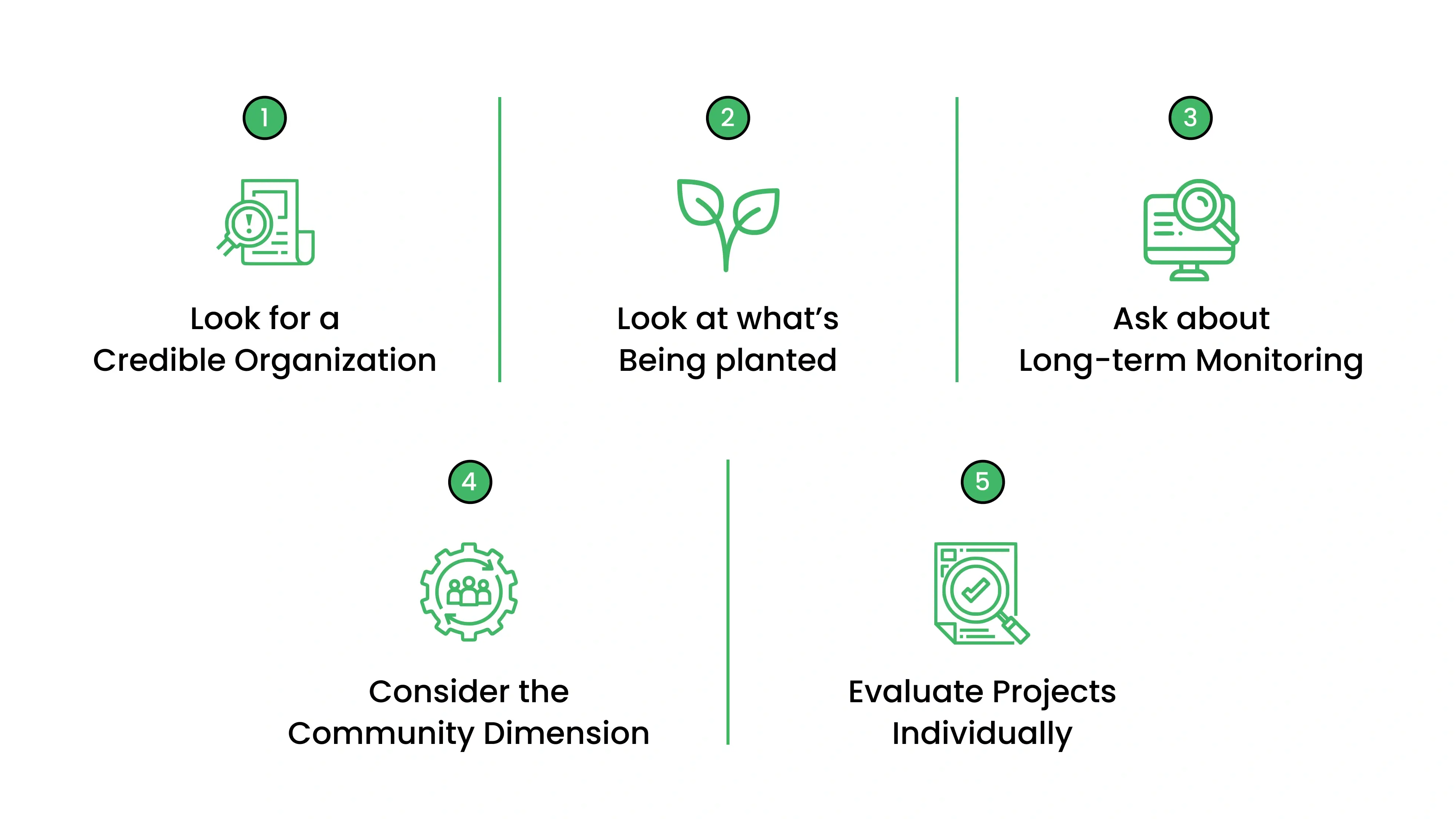
Knowing what makes a good offset is one thing. Finding a program that actually meets that bar is another. Here’s what to look for before you commit:
Not every organization offering tree-planting offsets operates to the same standard. Before you put money into a program, look into who's behind it, how long they've been running, whether their projects are independently audited, and whether they publish transparent reporting on their outcomes. A credible organization has nothing to hide and everything to show.
Native species planted in ecologically appropriate locations will always outperform a monoculture of fast-growing trees optimized for carbon numbers. A good program prioritizes biodiversity alongside sequestration, not instead of it. If the project documentation focuses solely on carbon and never mentions ecosystem health or species diversity, that's worth questioning.
A tree planted today needs to stand and grow for decades to deliver on its carbon promise. Credible programs have ongoing monitoring and maintenance built in, not just a planting event followed by silence. Look for projects that publish regular updates on forest health and survival rates.
Projects that involve and benefit local communities tend to last longer. When the people living alongside a forest have a stake in its survival, the forest is far less likely to be cleared or neglected. This isn’t just an ethical consideration but a practical one.
There’s no universal shortcut here. A program that looks impressive at a glance might have serious gaps when you dig into the details, and a smaller, less marketed project might be doing genuinely excellent work. Take the time to read beyond the homepage.

Offsetting carbon is only meaningful when it leads to real, lasting environmental impact. Plantd ensures your carbon offset efforts translate into measurable change by planting trees in the right regions, at the right time, and under the right conditions. This approach helps trees survive, grow stronger, and capture carbon effectively over the long term.
With verified projects, transparent tracking, and a focus on long-term ecosystem restoration, Plantd helps ensure your carbon offset efforts actually make a difference.