
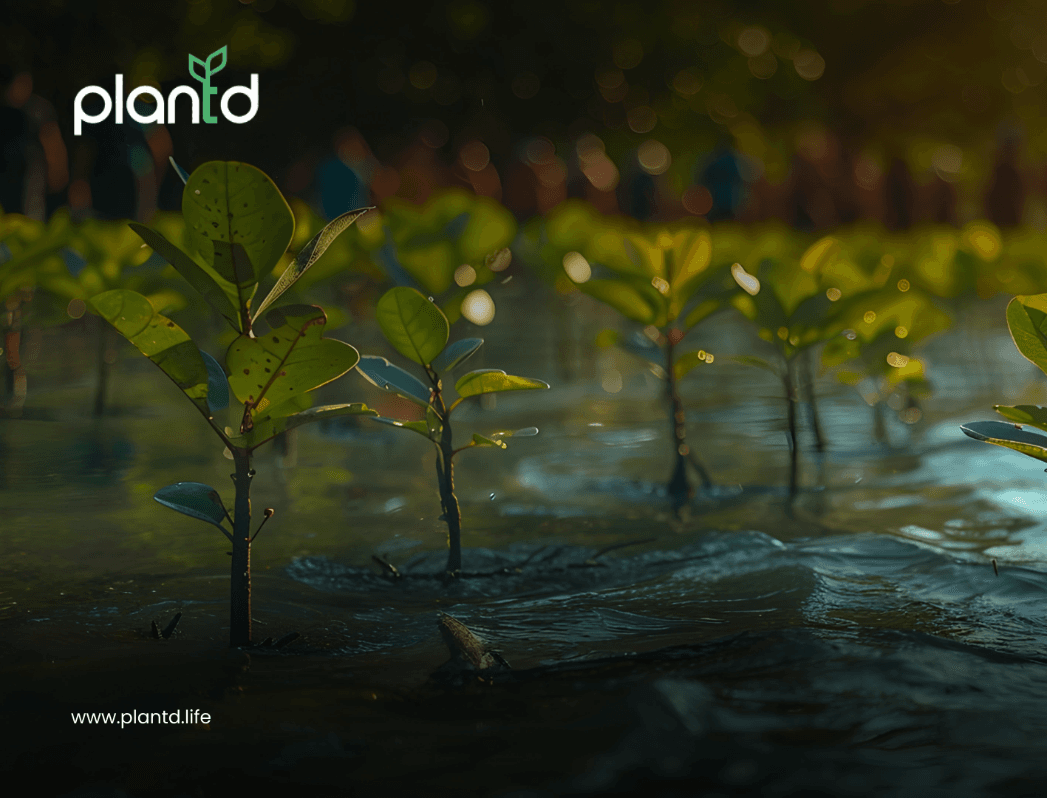
In several parts of Brazil’s coastline, there are areas where mangroves should be growing but are not.
The tide still comes in and goes out, but the dense roots that once held the shore together are missing, and with them the fish nurseries, bird activity, and natural protection these forests provided.
This kind of loss is not always obvious at first glance.
Mangroves do not disappear overnight. They decline when water stops reaching the land as it used to, when soil levels change, and when young plants can no longer survive the conditions around them. And once that balance is disturbed, they do not return on their own.
That is why restoring Brazil’s mangroves requires more than planting new saplings. It means rebuilding the exact conditions that allow them to grow in the first place.
In this blog, we’ll look at what caused the decline of Brazil’s mangroves, the science that enables their recovery, and how Plantd is helping rebuild biodiversity, strengthen climate resilience, and support local livelihoods.
Along several parts of Brazil’s coast, mangroves have been cleared or cut off from the water systems that keep them alive. Expansion of shrimp farms, urban growth near coastal zones, road construction, and poorly planned drainage channels have altered the natural flow of tides. In some areas, this has left mangroves sitting in stagnant water. In others, it has stopped seawater from reaching them at all.
These changes directly affect how the forest survives. Without regular tidal exchange, salt levels in the soil shift, nutrients stop circulating, and the soft, oxygen-poor mud that mangroves need begins to harden or erode. Even where adult trees remain standing, new growth often disappears because the conditions no longer support it.
The loss is not only ecological. Many small-scale fishing communities along the Brazilian coast depend on mangrove creeks as breeding grounds for fish, crabs, and shellfish. As these areas shrink or stop functioning, catches become less predictable and incomes decline. At the same time, coastlines that were once buffered by dense root systems are left more exposed to strong waves and storm surges.
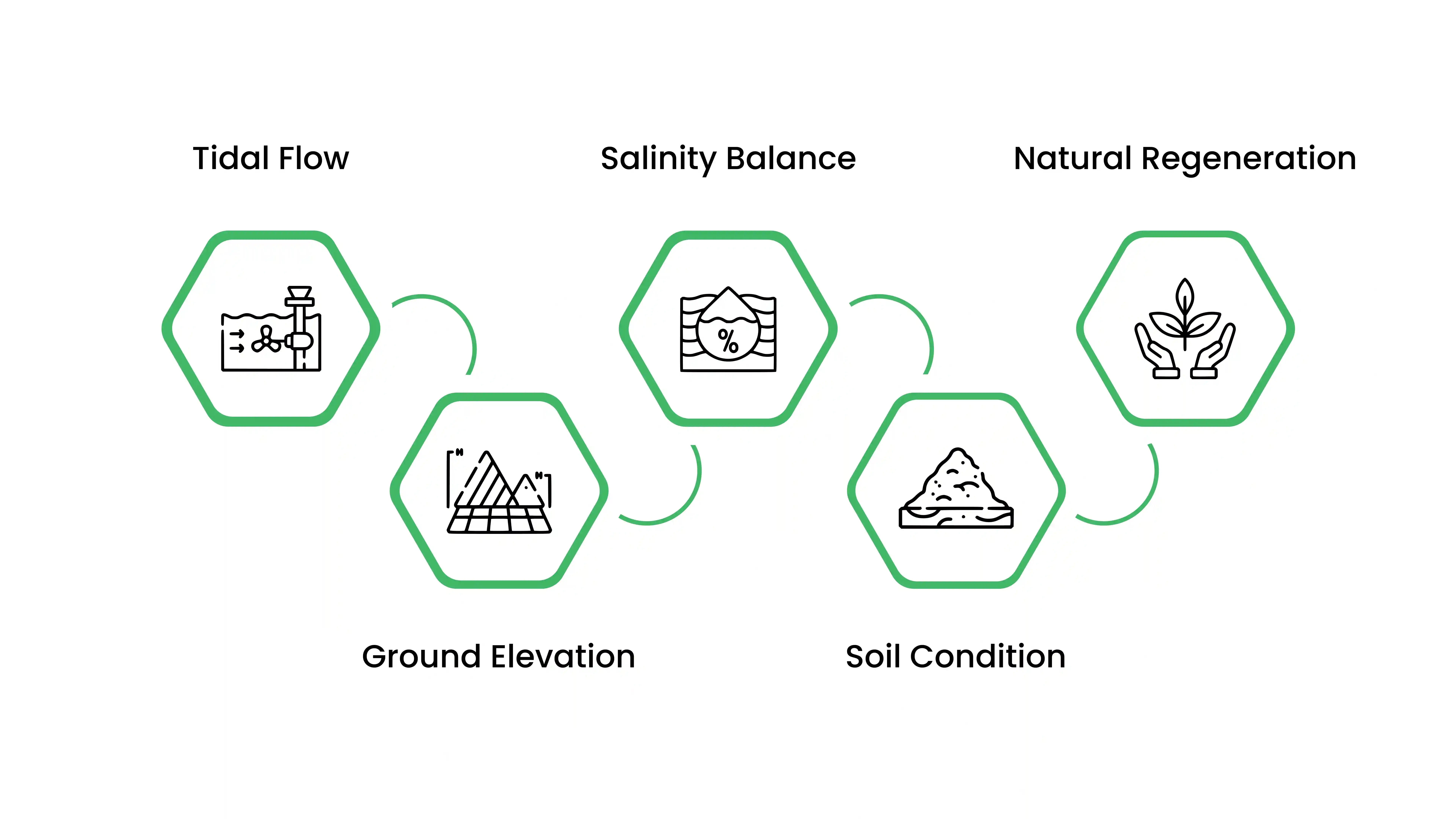
When mangroves are lost, planting new saplings seems like the most direct way to restore them. But along Brazil’s coast, many early efforts showed that survival has very little to do with the number of trees planted and everything to do with the conditions in which they are planted.
Mangroves live in areas that are flooded and drained by the tide every day. This constant movement brings nutrients, regulates salt levels, and keeps the soil in the right condition for roots to breathe. When tidal creeks are blocked or redirected, water either becomes trapped or fails to reach the site altogether. In both cases, young plants struggle to survive because the natural rhythm they depend on is gone.
Mangroves grow within a narrow vertical range along the coast. A difference of just a few centimeters in ground height can determine whether a seedling gets the right amount of water. In degraded areas, sediment build-up or erosion often shifts the surface out of this range, placing new plants in conditions where they cannot establish.
These forests rely on a delicate mix of seawater and freshwater. Changes in drainage patterns or the loss of tidal exchange can make the soil either too salty or not saline enough. Both extremes prevent healthy growth and stop natural regeneration.
The mud that supports mangroves is soft, rich in organic matter, and low in oxygen. This allows roots to spread and anchor the tree. When the soil dries, compacts, or washes away, it loses this structure. Even planted saplings cannot form stable root systems in these conditions.
In places where the original conditions are restored, mangroves often begin to return without large-scale planting. Seeds carried by the tide settle naturally, and new growth spreads in a pattern that matches the environment. This creates forests that are stronger, more diverse, and able to sustain themselves over time.
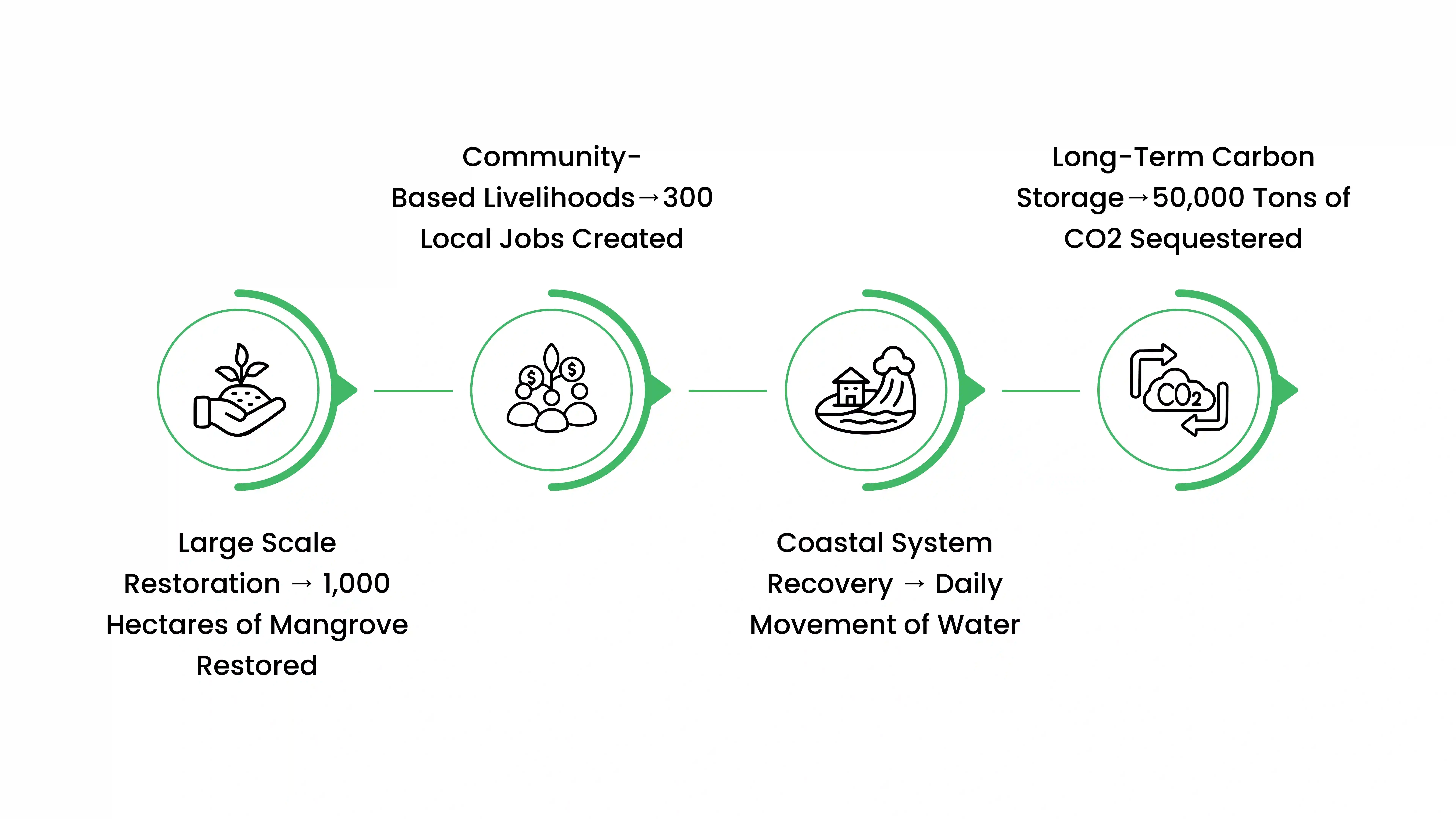
Plantd’s Brazil Mangrove Restoration project focuses on restoring mangroves by recreating the conditions they need to grow and expand naturally, rather than relying on short-term planting. Here’s what the restoration has made possible in Brazil’s mangroves:
The project is working to rehabilitate large stretches of degraded coastline, aiming to restore 1,000 hectares of mangrove forest. As these areas begin to reconnect, fragmented mangrove patches turn into continuous habitat again, allowing marine life to move more freely between breeding and feeding grounds.
Restoration activities are carried out with local participation, creating around 300 nature-based jobs linked directly to the recovery of the forest. This ensures that the work continues beyond the initial intervention and that the restored areas are protected and maintained over time.
By reopening blocked tidal channels and stabilizing the ground where needed, the daily movement of water returns to areas where it had been disrupted. Once this natural flow is restored, mangroves begin to grow in patterns that follow the original forest rather than in fixed plantation rows.
As the restored areas return to active growth, they begin capturing carbon in both their above-ground biomass and the deep, organic-rich soils beneath them. At the current scale of restoration, this is expected to store around 50,000 tonnes of CO₂, turning the recovering mangrove into a stable, long-term carbon sink that continues to accumulate climate benefits as the forest expands.
Large-scale mangrove recovery does not happen through a single intervention. It grows over time as more degraded areas are brought back into active restoration and protected for the long term. Here is how you can help restore Brazil’s mangroves:
Science-Based Restoration: Look for initiatives that begin by restoring natural water flow, soil conditions, and native species patterns. Projects grounded in ecological science create forests that can sustain themselves and continue expanding over time.
Community Partnership: Successful restoration is achieved through the involvement of local communities. This ensures that the work is maintained, protected, and closely tied to long-term livelihoods.
Biodiversity Recovery: Strong projects are designed to bring back entire habitats, not just tree cover. The return of fish nurseries, birdlife, and coastal species is a key sign that the mangrove is functioning again.
Long-Term Protection: Mangroves store carbon and stabilize coastlines only when they remain intact. Supporting projects with ongoing monitoring and protection ensures that the impact lasts for decades.
Choosing restoration that follows these principles helps rebuild coastal ecosystems in ways that are measurable, resilient, and beneficial to both nature and the communities that depend on it.
Mangrove restoration is one of the few climate solutions that strengthen biodiversity, protect coastlines, and support livelihoods simultaneously. In Brazil, this work is already bringing degraded coastal areas back into active growth and turning them into long-term carbon sinks.
By supporting science-led restoration through Plantd, you become part of a measurable process that continues to expand year after year. Each restored hectare helps reconnect habitats, stabilize fisheries, store more carbon in the soil, and create reliable income for coastal communities.
The impact does not stop at the project boundary. As more mangrove areas recover, entire stretches of coastline become more resilient to storms, erosion, and rising sea levels.
Rebuild a coastal system that will sustain life for decades to come.